
Never Trust The Autorouter
Auction-floor lab sourcing, home robot sketches, revisiting EDA's oldest unresolved promise, and more.


Happy long weekend. With how quickly things have moved over the last year, I still find that the best ideas worth surfacing, and the best writing we do, come from a place of genuine curiosity. More than anything, I hope this newsletter gives you that feeling too.
Onto the issue: liquidation auctions as a stealth procurement channel for hardware teams, early sketches behind Weave's home robot, a deployment-first definition of "Physical AI," and a taxonomy on the art of debugging circuits.

Interesting Links
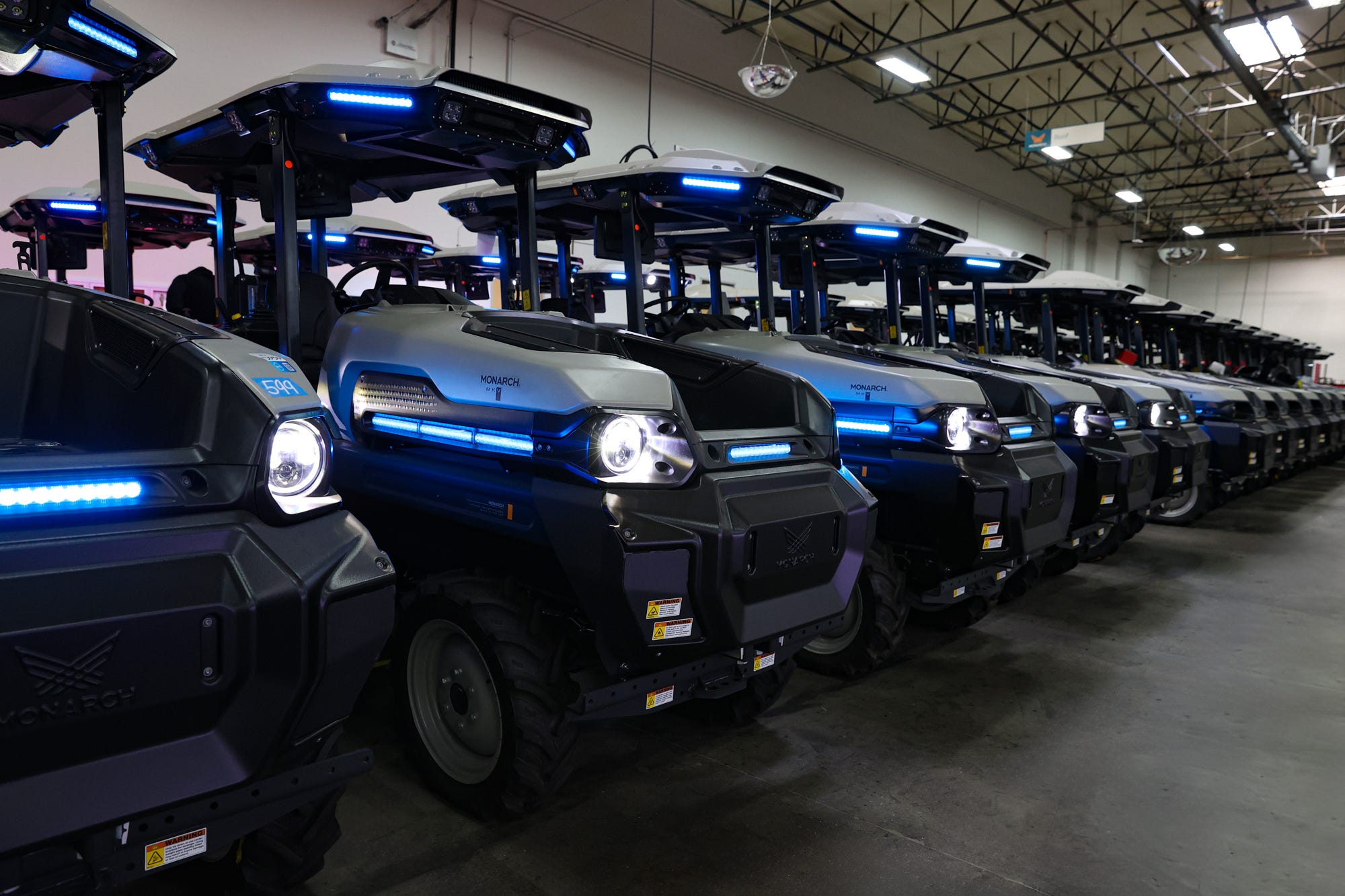
A loosely guarded secret of hardware teams and engineering lab managers is to scour liquidation auctions for equipment on pennies on the dollar. When companies fold, whole labs go up for sale and you can rebuild yours from the graveyard of past startups. In the Bay Area, liquidators like Silicon Valley Disposition run frequent auctions, and national aggregators like HiBid aggregate listings if you don’t mind arranging freight. Find equipment like lab stools, a Keysight U1253B multimeter, or, if you’re feeling particularly ambitious, the remnants of a $240M+ agriculture autonomy bet: autonomous EV tractors.
Engineering is often less about what you know and more about knowing how to investigate the unknown. Especially as AI commoditizes access to information and calculation, a cultivated intuition remains uniquely yours. The Art of Debugging Circuits (Or: How I Learned to Stop Worrying and Love Analog) opens with the question that really matters: is the schematic wrong, or did the circuit on the bench become something else? Practical habits include an emphasis on neat construction to save yourself the debugging pain of tracing wires, using a multimeter’s continuity mode to check for shorts, really understanding how to use an oscilloscope (triggering, coupling modes, 10x vs 1x probes, keeping ground clips on ground), and most importantly, treating debugging as thorough investigation, not random measurement. As Williams puts it - circuits aren’t magical, physics is never wrong, and the apparent conflict between them is a failure of the user’s logic.
IT IS IMPOSSIBLE TO EFFECTIVELY DEBUG A CIRCUIT IF YOU DO NOT UNDERSTAND ITS SCHEMATIC AND DO NOT KNOW HOW IT IS SUPPOSED TO WORK.
— Socrates— D. Elliott Williams
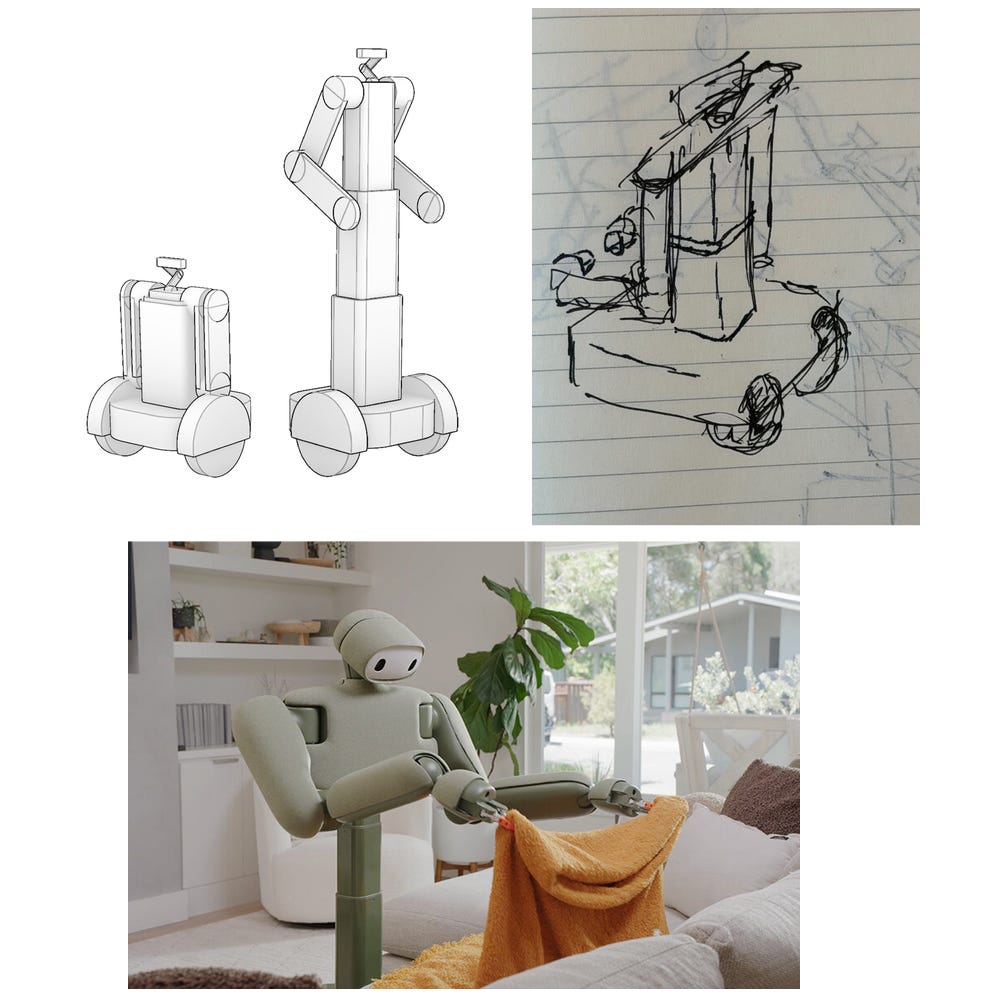
Weave Robotics launched Isaac 1 last week, and for all the attention around shipping a home robot to customers later this year, the real charm is in the public trail showing how polished hardware once began as a set of approximations. Half-resolved sketches, CAD blocks floating in space, and a loose idea slowly collapsing into constraints. The end result looks inevitable in retrospect, but it almost never feels that way at the beginning.
For anyone who has felt confused or simply unconvinced by the phrase “Physical AI,” A Boring Definition of Physical AI strips away the marketing theater and provides an actionable definition. The section to pay attention to after the definition is the deployment implication. Once non-deterministic software enters the control loop of a machine, someone has to absorb the variance. In software, a bad output can often be retried, but real machines are not always afforded the same luxury. That pushes value away from “AI” in the abstract and toward whoever owns deployment. The author collapses it into three archetypes: 1) operators who wrap robotics inside a service business, 2) integrators who make these systems work inside someone else’s operation, and 3) robot builders who pick specific verticals where the machine earns its keep.
“Physical AI is non-deterministic software running in the control loop of a machine. A learned policy that perceives through sensors, acts through hardware, and then perceives again as its own actions keep changing the world it is sensing.” — Gabriele Tinelli
Engineers practice making parts strong. Making one usefully weak is a separate skill - compliant enough to bend, tough enough to survive it. A 2021 review of bending setups provides the basic context for working with and testing flexible electronics: surface strain (and stress) scales as thickness over radius (ε ≈ t/2R), while resistance to bending scales as thickness cubed. Cut a 50 µm film to 25 µm and the strain at a given radius halves while bending stiffness drops eightfold: “weaker” yet more survivable are the same move. Textiles reach the same end from the other side: a load-bearing fiber can’t be thinned without giving up the tension it carries, so you preserve the cross-section and split it into filaments that slide past one another. There is no perfectly strong or compliant material, only the right one for its constraints; soft goods go on soft bodies, and “strong enough” beats as-strong-as-possible at delicate interfaces.
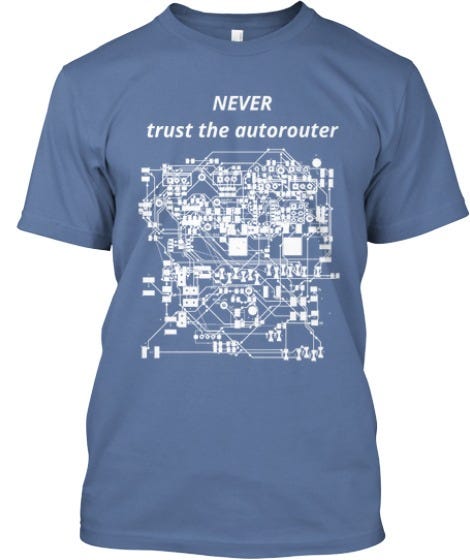
Sponsored: A useful technical history comes from Quilter on one of EDA’s oldest unresolved promises: the autorouter. Similar to LLMs reviving decades-old neural network ideas with more data and compute, PCB autorouting traces back to early grid-based pathfinding work at Bell Labs in the 1960s, then runs through decades of maze routers, shape-based routers, and tools like Specctra. The premise was always sound: let software do the tedious work of connecting nets. The problem, and the source of so much skepticism from PCB designers, is that traditional autorouters optimized for the narrowest version of the job. Tools measured success exclusively by completion rate (how many nets can be connected without violating design rules). PCB layout is not just routing though; it’s also placement, power distribution, impedance, manufacturability, and the quiet physics that turn connected copper into a board a designer can ship.
And a couple of fun links to round out the week:
Leo from Humba Ventures is hosting a six-week, paid fellowship for operators who want to peek behind the curtain of early-stage deep tech investing. Applications close 7/09.
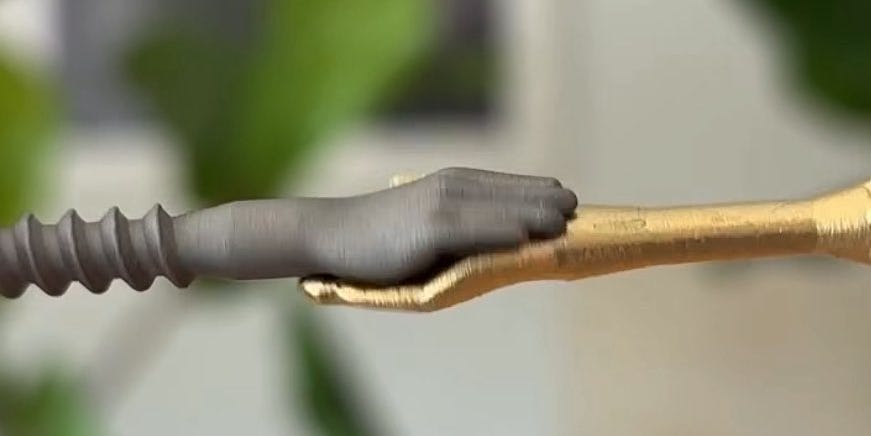
A literal hand screw, complete with a matching bit.
Presented by Onshape: Professional Access, 6 Months Free
Onshape provides browser-based CAD and PDM that empowers engineering teams to design and iterate without the friction of files, manual versioning, or local installs. Early adopters in diverse industries report up to 60% faster collaboration workflows and fewer errors, allowing teams to innovate and move designs forward more confidently. With the Onshape Discovery Program, qualified users get up to six months of free Professional access, making it easier to evaluate modern CAD workflows and their impact on productivity.
Learn more below.

Startup News
Queue emerged from stealth with $12.6M in seed funding to build a fully autonomous robotic pharmacy for prescription fulfillment. The startup’s system takes sealed wholesale pill bottles from one end and produces filled prescription vials out the other. The company is targeting pharmacy labor shortages, store closures, and declining unit economics by automating the physical dispensing and verification layer itself, with a working prototype already deployed with a major national pharmacy chain. AlleyCorp led the round following a $6M pre-seed led by Riot Ventures.

Even Realities raised $150M in pre-Series B funding at a $1B valuation to scale its display first smart glasses. Unlike camera-focused glasses, the Shenzhen-based startup skips the camera and uses a heads-up display built into the frames, controlled by a companion ring. The company says it has sold more than 10,000 pairs with the U.S. now its fastest growing market. Meituan and Tencent led the round.
Fun fact: Palmer Luckey was spotted wearing a pair of Even smart glasses during a TED talk last year, using them as a heads-up teleprompter.
CarbonSix raised $40M in Series A funding to develop robotic intelligence software and robotic hands/manipulators for manufacturing lines. The company is positioning itself around deployment-ready automation tools with systems that can be integrated into factories and improve from task-specific operational data collected during use. The round was co-led by DSC Investment and LB Investment, with participation from Korean and U.S. investors.
Luxonis raised $14M in Series A funding to scale its machine vision cameras and software for robotics and intelligent automation. The company builds cameras that combine multiple vision sensors with on-device compute, and its open-source software stack for building edge perception systems. The latest devices support local AI models, high-accuracy depth sensing, and low-latency processing for applications like factory floors, warehouses, heavy machinery, and more. Denali Growth Partners led the round.
Open Jobs
More jobs added weekly on our job board. If you’re hiring, promote your open role here.
Early Career:
Scout AI is looking for a Junior Firmware Engineer in Sunnyvale, CA
Mid-Level:
OpenAI is looking for a 3D Printing Lab Technician, Robotics in San Francisco, CA ($250-295K)
Pronto is looking for a Robotics Test Engineer in San Francisco, CA ($298-$376K)
Senior to Staff:
CoreWeave is looking for a Senior Product Manager (Supply Chain) in Livingston, NJ
Valar Atomics is looking for a Senior Mechanical Engineer in Hawthorne, CA
Internships:
The Boring Company is looking for a Mechanical Engineering Intern (Year Long) in Bastrop, TX
Tools From Our Sponsors
Design & Simulation
Duro — AI-native PLM that centralizes part data, manages change orders, and connects the whole stack so your team can focus on execution, not administration.
nTop – Computational design to accelerate product development.
Onshape for Startups – Free access to Onshape Professional or Onshape Government (compliant with ITAR/EAR) for hardware startups and entrepreneurs.
Manufacturing
Express Manufacturing, Inc. – Southern California’s largest EMS provider with 40+ years of end-to-end electronics manufacturing expertise.
Fictiv – On-demand custom manufacturing from prototype to production.
Loombotic – Instant-quote custom wire harnesses. Upload drawings or design online, fast turnaround.
Blitzpanel – Custom control panels made fast and easy. Design online for instant pricing or let us design for you.
Access Every Link We’ve Ever Shared 🎞️
Refer three friends to Hardware FYI and unlock our full archive.
Missed an issue? Hunting for that one link? Every tool, guide, and article we’ve ever shared is in here.
P.S. If you find something interesting—an article, tool, funding round, project, really anything—send it our way.
P.P.S. 20,000+ engineers, founders, and operators read this newsletter. If you want to reach them, get in touch.
Hey guys, thanks for featuring my Boring Definition of Physical AI! Great surprise!