
Texture Lives in the Tooling
CMF as manufacturing instructions, hidden surface texture in the PS5 controller, and Skunk Works rules for small teams


Topics worth your time this issue: the 40,000 tiny symbols laser-engraved into PS5 controller tooling, a practitioner’s guide to CMF selection, the Skunk Works model as a playbook for small teams, and exploring Midjourney's rationale for a medical division.

Interesting Links
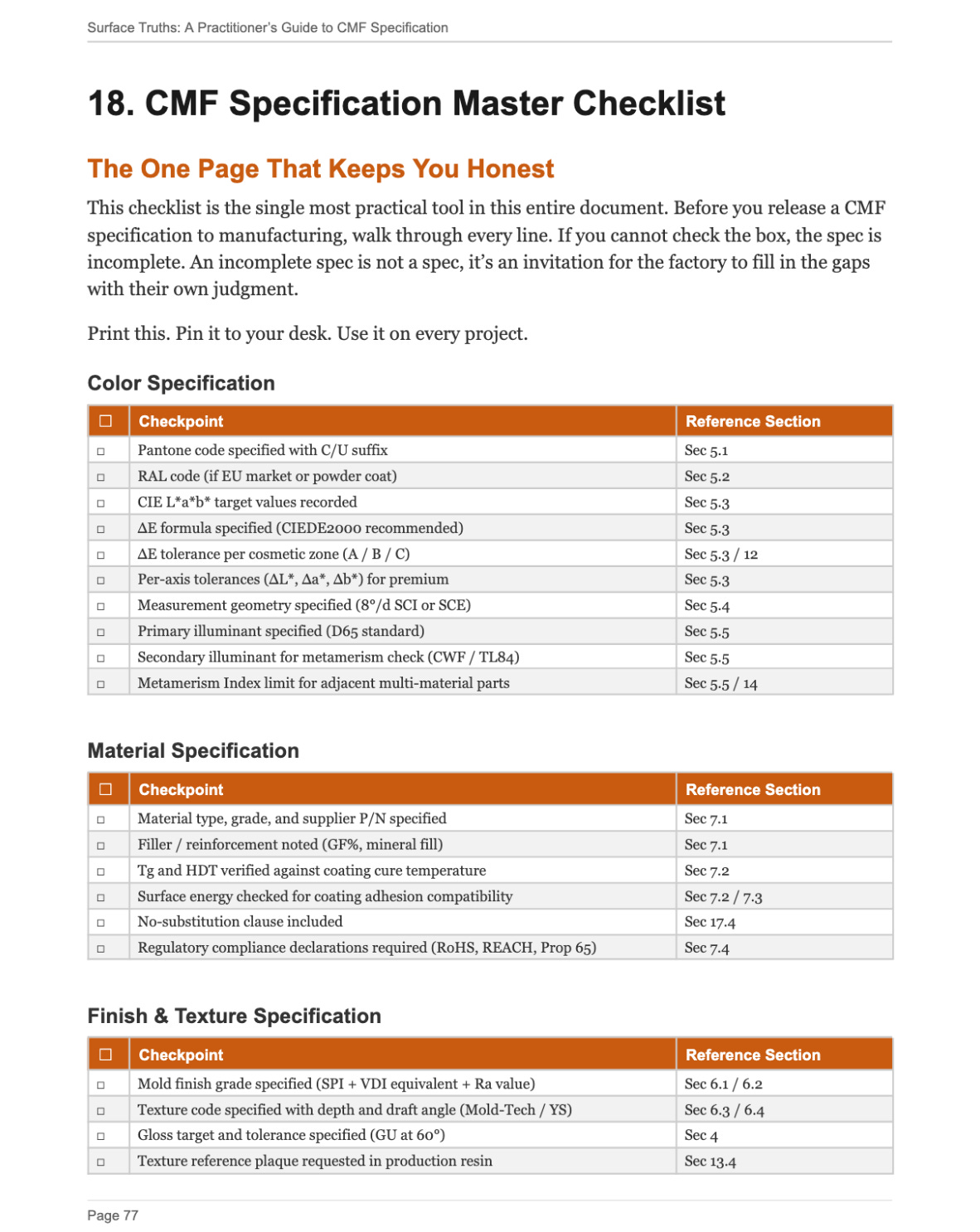
Surface Truths: A Practitioner’s Guide to CMF Specification is a useful guide to the messy handoff between a designer’s aesthetic intent and a factory’s actual instructions for color, material, and finish. Digital tools are useful for concepting, but for anything cosmetic, physical samples are the single source of truth. The guide’s framing is to treat CMF less like art and more as a manufacturing instruction set that a supplier can reproduce: CAD callouts, annotated drawings, golden samples, limit samples, texture plaques, SPI/VDI equivalents, durability tests, and inspection criteria. It gets into the unglamorous details too, like why RGB values aren’t useful for production color matching (screens render color differently), why a color spec needs L*a*b* targets and ΔE tolerances (so color can be measured, not argued), and why parts should be checked under multiple lighting conditions for metamerism (two parts can match under one light and drift under another). Every missing CMF callout becomes someone else’s decision, likely at the supplier, and usually not the way intended.
A good example of CMF hides in plain sight on the PS5 controller, where 40,000 tiny PlayStation symbols function as the grip texture. Tiny squares, circles, triangles, and crosses are formed into the shell of the controller as molten ABS fills microscopic features cut directly into the tool steel. Sony reportedly tested multiple hand-sketched patterns, digitized them, and tuned the texture until it matched the right ergonomic balance. The final pattern uses two height layers, ~15 and 30 microns tall, with larger symbols about half a millimeter wide. Cutting fine details across a curved grip requires the use of a multi-axis laser engraving machine like ones from GF Machining Solutions that specialize in 3D laser texturing. Map a digitized pattern onto the 3D tool surface, then ablate the steel layer by layer.

In 1943, Kelly Johnson was given 180 days to build America’s first jet fighter. He had it flying in 143, working out of a rented circus tent. That improvised setup became Skunk Works, the Lockheed shop behind the U-2, F-117, and SR-71, which held the air speed record for half a century. Skunk Works: A Personal Memoir of My Years at Lockheed is the source text to read unabridged, but if you’re short on time, this article distills Johnson’s 14 rules as a playbook for replicating the model: restrict headcount “in an almost vicious manner,” fund the program on time so nobody’s “running to the bank,” and push authority down toward ICs as possible. It also recommends paying the best ICs far more to remove the inexorable pull toward managing growing teams. Vannevar Bush pioneered related practices in the 1940s, keeping civilian scientists out of the military’s chain of command and on separate funding so radar and the proximity fuse could get out the door. For more on Bush’s philosophy, we recommend reading Pieces of the Action and As We May Think, his 1945 essay that anticipated the personal computer and the web.
A couple new product announcements made headlines last week:
Midjourney, of all companies, announced a medical division developing a full-body ultrasound scanner. The proposed experience is closer to a spa visit than traditional radiology: step onto a platform, get lowered into a shallow pool of warm water, and pass through a ring of ultrasound transducers that reconstruct a 3D map of the body. The hardware licenses Butterfly Network’s ultrasound-on-chip technology, and the current version uses 40 chips, roughly 8,960 active transducer channels, and ~2 petaflops of compute to process 17 GB/s of raw acoustic data per scan. The skepticism is obvious: medical hardware is a regulated, validation-heavy category with slow development cycles; but the more interesting part is that a profitable, venture-free AI company is treating hardware as the next frontier. Midjourney’s founder has been open about the company strategy as less an AI platform play, and more of a well-funded lab for pursuing specific interests. He frames it as build one less data center and spend the money on “crazy science projects.”

Concept renderings for the Midjourney Spa, a four-floor bathhouse planned for SF’s Union Square in late 2027. Opal Camera is rebranding to Opal Electronics and moving into AI hardware, starting with an audio device reportedly launching in the next few months. Opal had previously sold more than 50,000 webcams and manufactured in Taiwan. As it shifts focus, the company is taking a notably un-Silicon Valley approach to sunsetting its webcams by pledging to open-source the design files, PCB schematics, and software so owners can keep them running.
A couple fun links to round out the week — two libraries that double as architectural feats and an interesting opportunity:
Biblioteca Vasconcelos in Mexico City, with floating stacks of books suspended above.


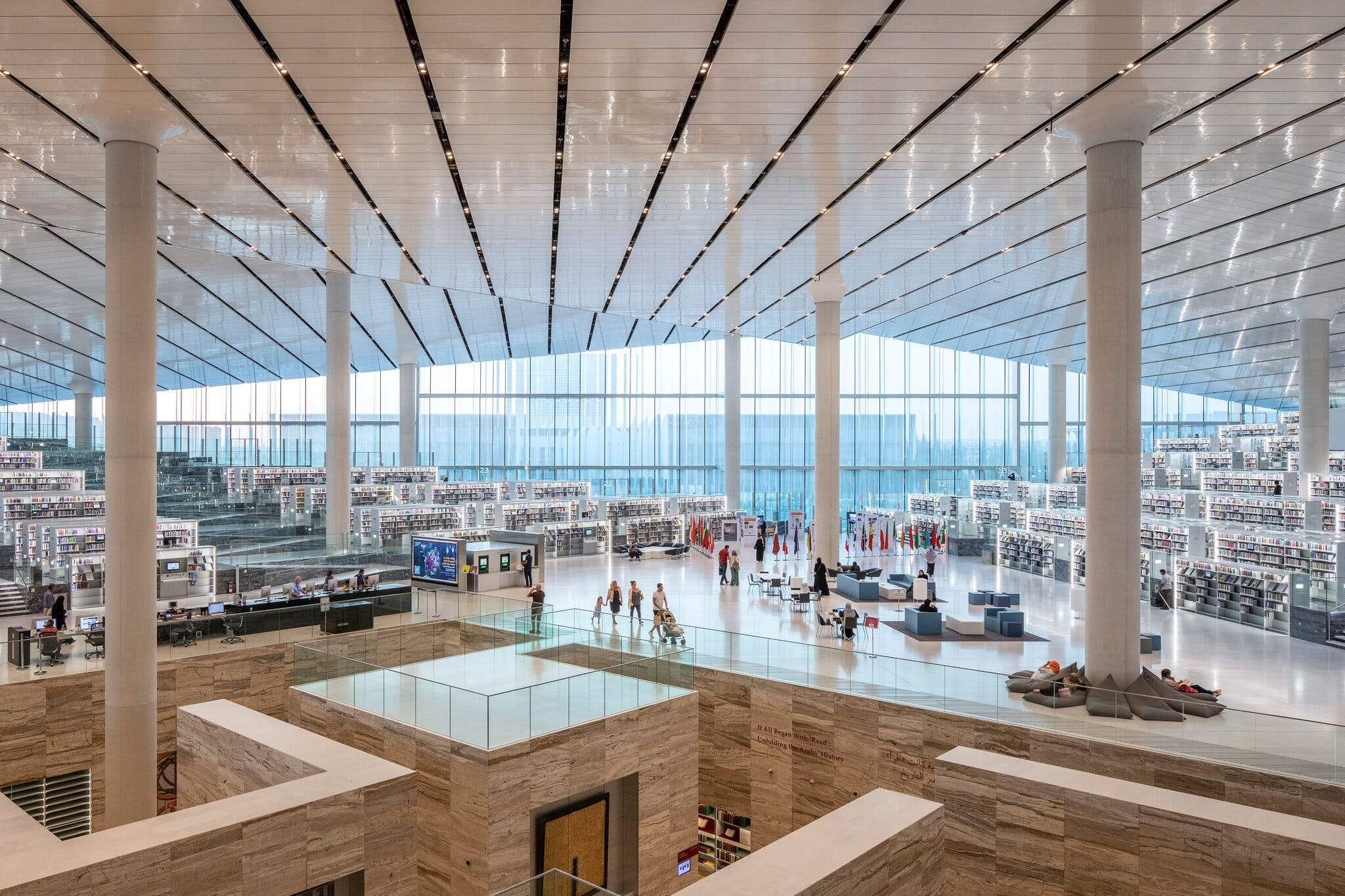
Qatar National Library in Doha, where the shelves are built into the slope of the building itself.
EEVblog, the long-running corner of the electronics engineering internet, is hiring an engineering content creator in Sydney, Australia. Of the now 2,000+ video catalog, a personal favorite is his first principles debunking of long-range wireless charging.
Presented by Onshape: Professional Access, 6 Months Free
Onshape provides browser-based CAD and PDM that empowers engineering teams to design and iterate without the friction of files, manual versioning, or local installs. Early adopters in diverse industries report up to 60% faster collaboration workflows and fewer errors, allowing teams to innovate and move designs forward more confidently. With the Onshape Discovery Program, qualified users get up to six months of free Professional access, making it easier to evaluate modern CAD workflows and their impact on productivity.
Learn more below. 👇

Startup News
XDOF emerged from stealth with $70M in funding to build the data layer for robot foundation models. In practice, that means teleoperation rigs, collection workflows, cleaning tools, and annotation systems for labs that do not want to run giant robot data farms themselves. The company grew out of Berkeley research on GELLO (a low-cost robot arm teleoperation system), and says it already has 20 customers including frontier AI labs.
Limitless Labs raised a $20M Series A round to build AI tools for CNC programming. The company’s software sits inside existing CAD/CAM workflows, reads a design file, checks it against the target machine’s constraints, then helps select tools, plan operations, and generate toolpaths. The company says it is now in production with customers including Blue Origin, Cadillac Formula 1, and ISCAR, among others. The round was led by Dell Technologies Capital and Square Peg.
Odyssey raised a $310M Series B round at a $1.45B valuation to build general world models, or AI systems that can simulate physical environments and act inside them. The company has released several research systems focused on physics accuracy and multi-modal interaction. The round was led by Natural Capital, with participation from Amazon, AMD Ventures, Google Ventures, EQT, and In-Q-Tel.
Superlight raised a $21M Series A round to build electric box trucks for middle-mile logistics. The company’s first design is a clean-sheet EV truck designed around cargo volume and energy use, with the company claiming 50% more cargo capacity and 50% lower energy expense than comparable trucks. Superlight has logged 500,000+ kilometers of powertrain mileage, including commercial pilots in the UK, and plans to use the funding to finish its UK manufacturing facility and prepare vehicles for US customer testing. The round was co-led by Engine Ventures and 2150.
Open Jobs
More jobs added weekly on our job board. If you’re hiring, promote your open role here.
Sponsored:
GITAI, a space startup building robots for satellite servicing and lunar infrastructure, is hiring for a Mechanical Engineer in Los Angeles, CA
Early Career:
Base Power Company is looking for a Hardware Test Engineer in Austin, TX
Qualcomm is looking for a Systems Engineer (Sensors) in Santa Clara, CA
Mid-Level:
Xometry is looking for a Mechanical Engineer, AI Integration in Waltham, MA
Last Energy is looking for a Thermofluids Engineer in Austin, TX
Senior to Staff:
Astranis is looking for a Senior Director of Vehicle Engineering in San Francisco, CA
Form Energy is looking for a Staff Global Supply Manager (Stamped Metals) in Berkeley, CA
Tools From Our Sponsors
Manufacturing
Express Manufacturing, Inc. – Southern California’s largest EMS provider with 40+ years of end-to-end electronics manufacturing expertise.
Fictiv – On-demand custom manufacturing from prototype to production.
Loombotic – Instant-quote custom wire harnesses. Upload drawings or design online, fast turnaround.
Blitzpanel – Custom control panels made fast and easy. Design online for instant pricing or let us design for you.
Design & Simulation
nTop – Computational design to accelerate product development.
Onshape for Startups – Free access to Onshape Professional or Onshape Government (compliant with ITAR/EAR) for hardware startups and entrepreneurs.
Access Every Link We’ve Ever Shared 🎞️
Refer three friends to Hardware FYI and unlock our full archive.
Missed an issue? Hunting for that one link? Every tool, guide, and article we’ve ever shared is in here.
P.S. If you find something interesting—an article, tool, funding round, project, really anything—send it our way.
P.P.S. 20,000+ engineers, founders, and operators read this newsletter. If you want to reach them, get in touch.