
The Cheap Drone Problem for Tanks
Drone designs, medieval cathedral construction, a mirror in orbit, and more.


Topics worth your time: how cheap drones are changing the economics of armored warfare, what Sainte-Chapelle reveals about engineering before formal theory, Reflect Orbital’s proposed sunlight-bending satellite, and a map of the engineering software landscape.
We’re back in SF for another happy hour on August 11. Register here!

Interesting Links
More often than not, the design lineage in early hardware “markets” fans out across strange solution spaces before converging on a standard form. One particularly good example is World War I tank design. The UK eventually landed on the reasonably effective rhombohedral Mark V, Germany the armadillo-like A7V, and France pioneered the nimble Renault FT-17 (and the less effective Saint Chamond). Before good field data exists, several quite different designs can look right. That makes getting into the real world quickly and cheaply far more important than trying to be perfect out of the gate, when the Pareto-optimal tradeoffs between competing constraints are still unclear. Countering new military technology often requires building competing designs, and rarely allows a nation to export either its design or the manufacturing capacity behind it. Weapons of war often create this environment.
The Ukraine-Russia war is producing a similar early-market divergence in drone designs with fiber-optic FPVs, fixed-wing motherships, quadcopters, and more - which oddly enough appears poised to make 100 years of tank evolution moot due to the law of economic warfare. A $1000 drone destroying a $10 million platform is still a $1000 drone destroying a $10 million platform regardless of what cage you weld onto the turret.

A very practical use of the accelerometers and gyroscopes already inside a smartphone is Apple’s Vehicle Motion Cues used for motion sickness. When you read in a moving car, your inner ear registers acceleration while the screen gives your eyes no corresponding reference; smartphones like the iPhone use their IMU to drive small dots at the edges of the display, giving peripheral vision a cue that moves with the vehicle. This patent (US 12,561,864) describes the same basic mechanism more broadly: a semi-transparent geometric overlay that shifts and contracts with the device’s three-dimensional acceleration, including motion toward or away from the screen. While this capability has been technically possible since the earliest smartphones, it took nearly two decades for a product team to turn the sensor data into a useful human cue.

If you are ever feeling down about your math skills, remember that Sainte-Chapelle (and almost all ancient architecture) was built by people who never studied formal mathematics or geometry. Using heuristics developed over hundreds of years, the masons of the Sainte-Chapelle Cathedral were able to construct a much more compact arch system without having the ability to do proper calculations or having a standard length unit. By simply using rope, they were able to pin the width of adjoining wall sections to the proper structural characteristics needed to prevent buckling - all by laying rope and folding over the arch and marking specific fractions. While counterintuitive, engineering doesn’t always require science, and it’s a common misconception to think engineering emerged from the scientific method. People built cathedrals before there were architects, or engines before thermodynamics. Theory and formal expertise often arrive later to explain and refine centuries of discovery and practical knowledge.

The FCC has approved (or declined to deny) Reflect Orbital’s Eärendil-1 test hardware - a giant flying mirror to direct sunlight to solar farms, industrial sites, farms, and other places that wish it were always sunny. The company began with a simple observation: the largest available energy gradient is between the Sun and Earth, yet most of the Sun’s output passes into space. With deployable 59-by-59-foot Mylar mirrors, Reflect Orbital hopes to bend a small portion of that reality back toward the ground. Russia tested a similar concept in the 1990s with its Znamya experiments. The first launch briefly produced a moving patch of light across Europe, while a second mission failed after the reflector became tangled during deployment. While Znamya shuttered after the second deployment, its basic premise has become easier for private companies to revisit (roughly $12k–$32k/kg to LEO in the 1990s, versus $2.7k/kg on Falcon 9). Many more companies like Reflect Orbital represent the start of a new space race predicated on commercial interests.
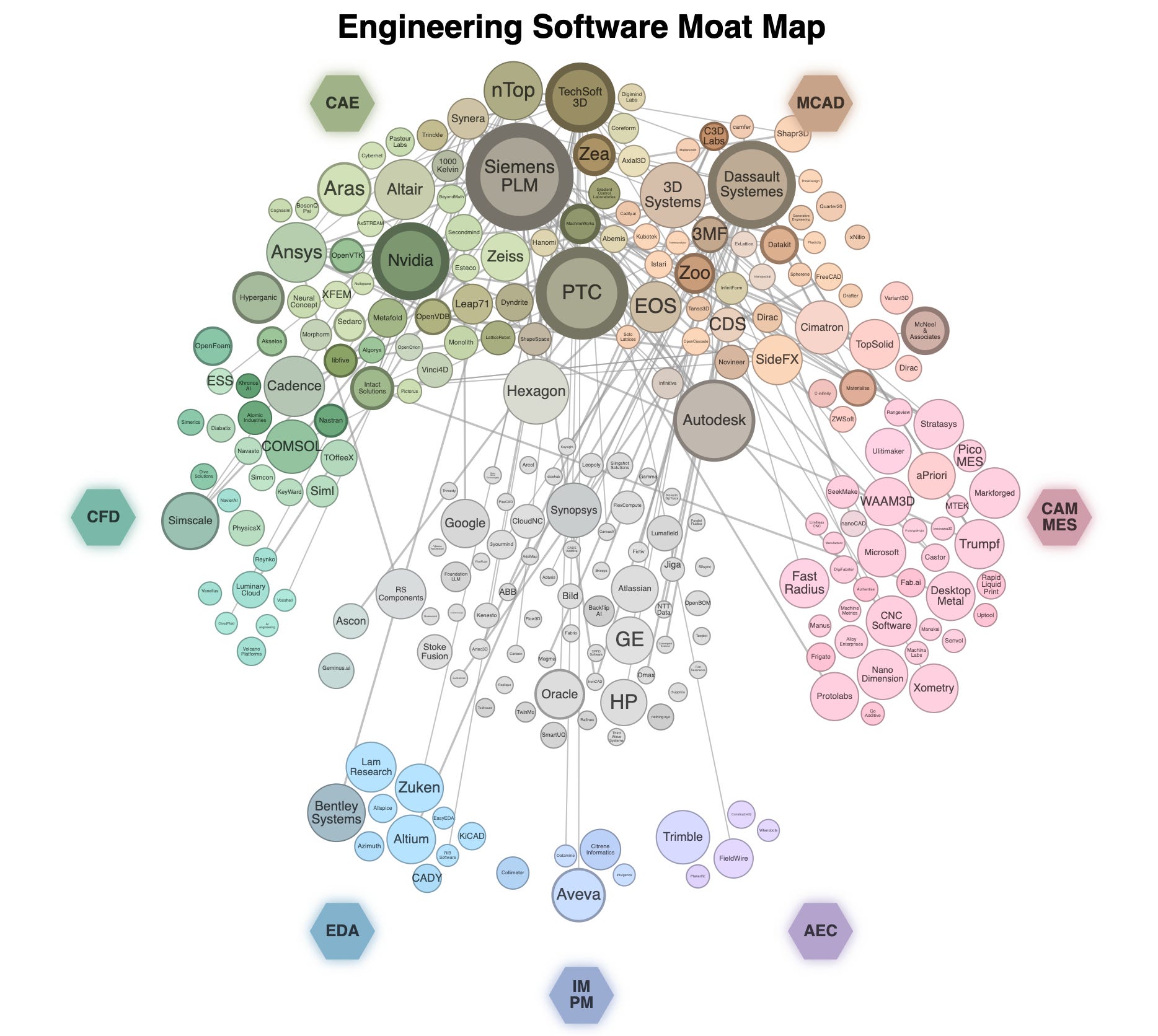
Blake Courter’s Moat Map is an attempt to sort through the 200+ companies now claiming some version of generative, AI-native, or radically faster engineering software. The map spans everything from CAD, CAM, EDA, MES, and more of the software alphabet soup. The open question is whether the new wave of tools expands the market, or instead hollows out the incumbents that once controlled it.
And a couple fun links to round out the week:
instro is a new open-source Python library for scripting lab instrumentation (think power supplies, multimeters, electronic loads, DAQs, oscilloscopes, PLCs) through a single API.
Our job board now has a company directory showing hiring momentum, seniority, locations, and last posted date, plus salary data based on posted pay ranges.
Presented by Onshape: Professional Access, 6 Months Free
Onshape provides browser-based CAD and PDM that empowers engineering teams to design and iterate without the friction of files, manual versioning, or local installs. Early adopters in diverse industries report up to 60% faster collaboration workflows and fewer errors, allowing teams to innovate and move designs forward more confidently. With the Onshape Discovery Program, qualified users get up to six months of free Professional access, making it easier to evaluate modern CAD workflows and their impact on productivity.
Learn more below. 👇

Startup News
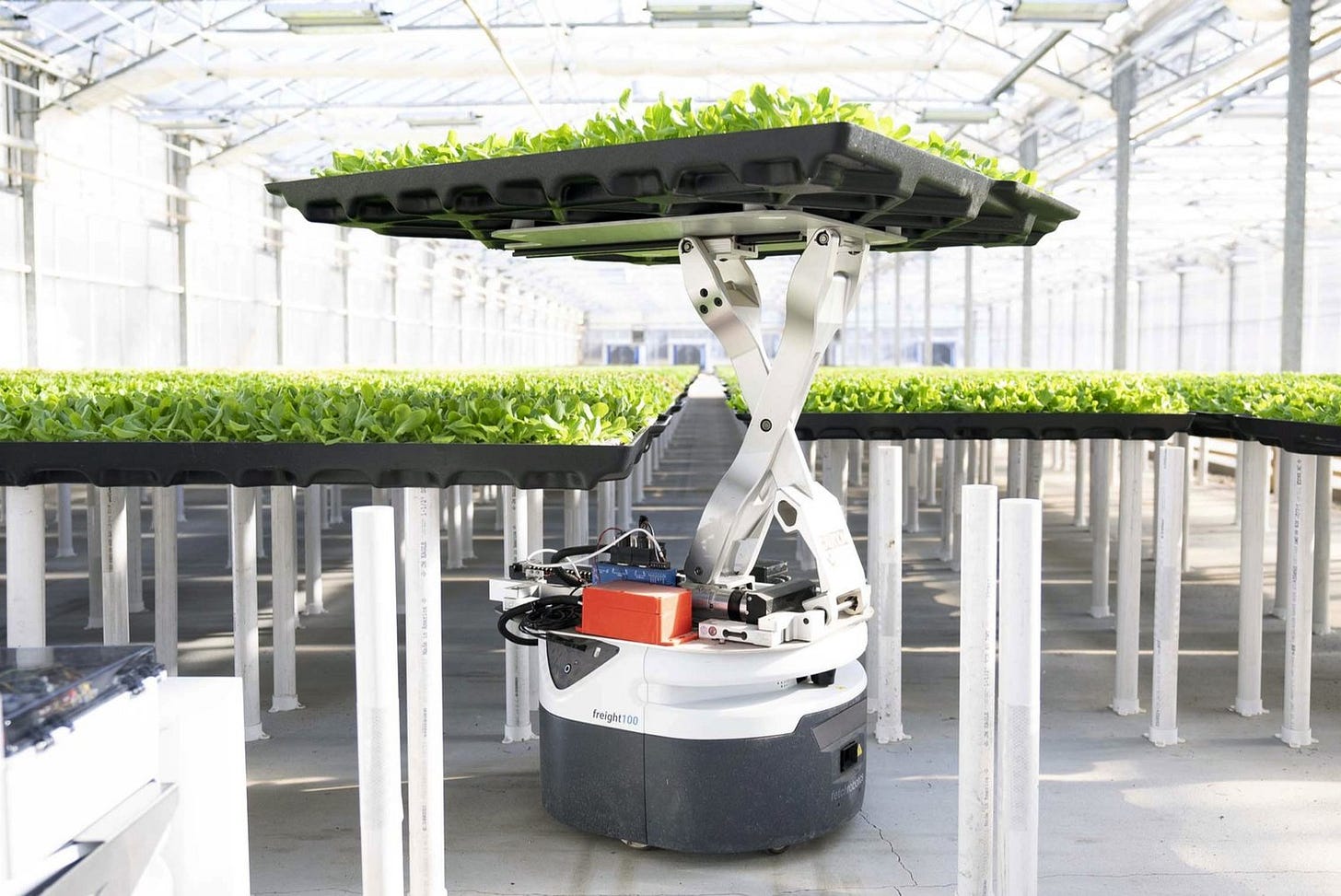
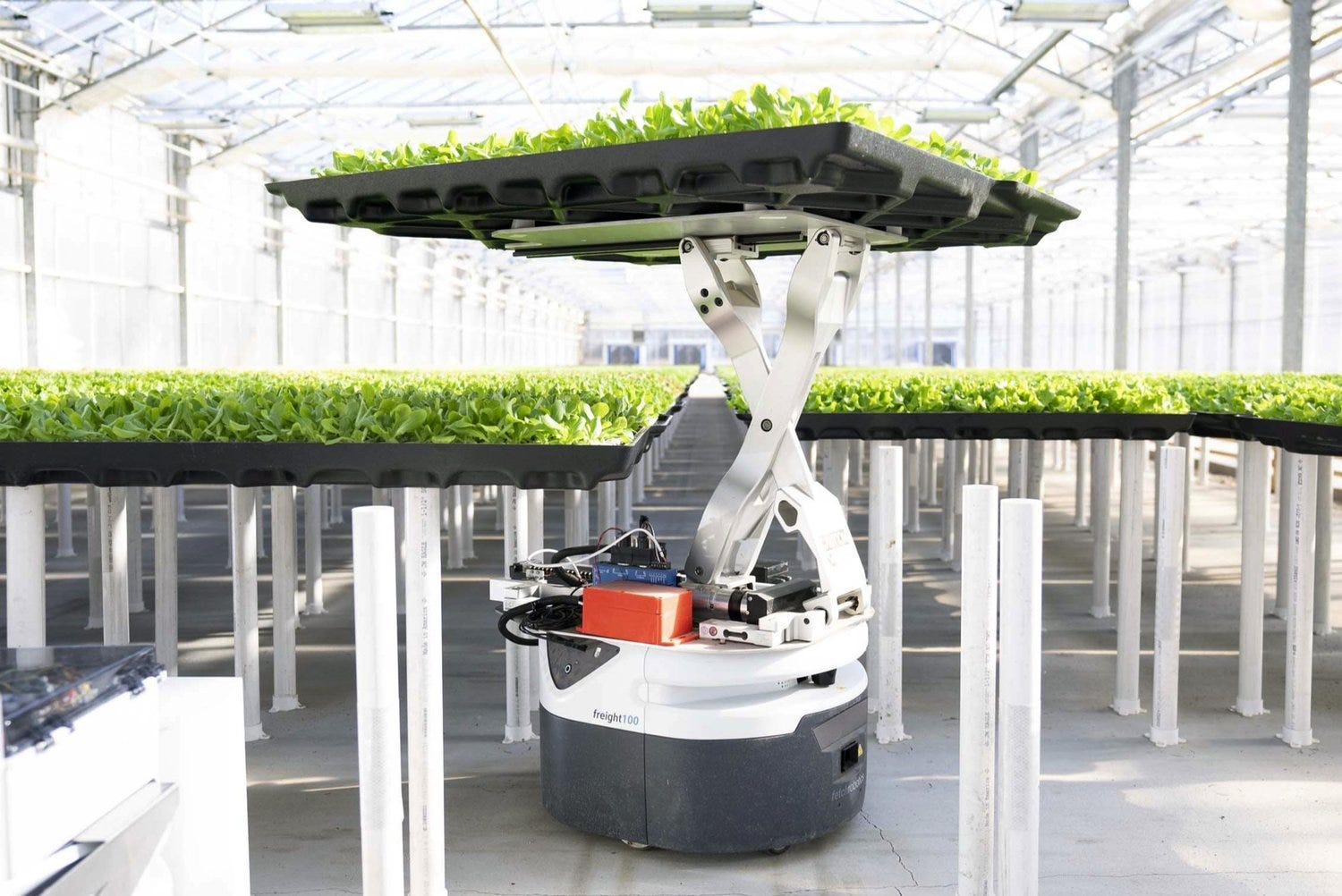
Hippo Harvest raised $30M in Series C funding to scale its robotics-enabled indoor growing system for vegetable produce. The company uses autonomous mobile robots inside greenhouses to monitor, tend, harvest, and automatically respace growing modules throughout the crop cycle. The capital will fund a 30-acre expansion at a new Hollister, California facility, and support commercialization of indoor-grown spinach after launching butter lettuce to retail buyers earlier this year. Cox Farms, North America’s largest greenhouse operator, led the round.
Venus Aerospace raised $91M in Series B funding to scale its rotating detonation rocket engine for hypersonic flight and space transportation. Unlike conventional rocket engines, a RDRE generates thrust from a continuously rotating detonation wave, with the promise of higher efficiency and performance. The Houston-based company recently flight-tested a 2,000 pound thrust version at Spaceport America. Mercury Fund led the round, with participation from Lockheed Martin Ventures
Quaise Energy raised $134 million in a first close of its Series B to build Project Obsidian, a commercial superhot geothermal power plant in central Oregon. The company uses millimeter waves to ablate rock rather than mechanically crush it, aiming to reach 300–500°C rock at depths beyond 5 km, where geothermal systems can produce far more power from a smaller footprint. Quaise recently drilled more than 100 meters through granite at full scale in Texas last year and is now approaching one kilometer, with first grid power targeted at Obsidian for 2030. Prelude Ventures led the round
Proxima Fusion raised €411 million to build Alpha, a stellarator fusion demonstrator designed to prove that its magnet system can confine superheated plasma long enough to produce net energy. The funding will support a full-scale model coil, high-temperature-superconducting cable and magnet production, and the manufacturing systems required to build Alpha near Munich. XTX Ventures and East X Ventures led the round, with RWE and Google participating.
Hive raised $15 million in seed funding to retrofit existing heavy equipment with a machine-agnostic autonomous driving system. The company installs sensors and its AI compute module on existing fleets like forklifts, excavators and haulers, then remotely supervises multiple machines through a common control layer rather than requiring customers to buy new autonomous equipment. SuperSeed led the round.
Open Jobs
More jobs added weekly on our job board. If you’re hiring, promote your open role here.
Early Career:
Northwood is looking for a RF Hardware Engineer (Early Career) in Torrance, CA
Mid-Level:
Etched is looking for a PCB Layout Engineer in San Jose, CA
Fluidstack is looking for a Reliability Engineer in Austin, TX
Senior to Staff:
OpenAI is looking for a Secure Manufacturing Stealth Investigator in San Francisco, CA ($288-425K)
Formlabs is looking for a Startup Founder in Somerville, MA
Internships:
HaloBraid is looking for a Mechanical Engineering Co-op (Fall) in Cambridge, MA
Tools From Our Sponsors
Design & Simulation
Duro — AI-native PLM that centralizes part data, manages change orders, and connects the whole stack so your team can focus on execution, not administration.
nTop – Computational design to accelerate product development.
Onshape for Startups – Free access to Onshape Professional or Onshape Government (compliant with ITAR/EAR) for hardware startups and entrepreneurs.
Manufacturing
Express Manufacturing, Inc. – Southern California’s largest EMS provider with 40+ years of end-to-end electronics manufacturing expertise.
Fictiv – On-demand custom manufacturing from prototype to production.
Loombotic – Instant-quote custom wire harnesses. Upload drawings or design online, fast turnaround.
Blitzpanel – Custom control panels made fast and easy. Design online for instant pricing or let us design for you.
Access Every Link We’ve Ever Shared 🎞️
Refer three friends to Hardware FYI and unlock our full archive.
Missed an issue? Hunting for that one link? Every tool, guide, and article we’ve ever shared is in here.
P.S. If you find something interesting—an article, tool, funding round, project, really anything—send it our way.
P.P.S. 20,000+ engineers, founders, and operators read this newsletter. If you want to reach them, get in touch.