


Weekend Wire #11: The Return of Supersonic Flight
February 1st, 2025

👋 Happy Saturday! This weekend’s highlights marks a major milestone in aviation: Boom Supersonic completed the first civilian supersonic flight in over twenty years since the end of the Concorde program. While Boom’s supersonic test of the XB-1 is a big milestone, we won’t see passenger traffic return until their flagship aircraft Overture is ready. It’s a good time to take a 50,000 foot view of what the return of supersonic flight could mean for aviation.
Interesting Chart: Perceived Level in Decibels 🔊
This chart from a 2019 NASA report measures the Perceived Level in Decibels (PLdB) of the Concorde and X-59 (NASA’s quiet boom R&D project delayed until mid 2025). We made the addition of Boom’s PLdB target for Overture highlighted in orange. Presently, civilian flight at supersonic speeds is prohibited over land. Boom is aiming for a target of 85 PLdB,—ten times louder than NASA’s quiet supersonic project, but twenty times quieter than the Concorde.
Concorde flights were restricted to subsonic speeds over land, only going supersonic during the transatlantic flight phase.

The noise comes from a sonic boom—though some marketing teams now call it a “sonic thump.” Candidly speaking, sonic boom sounds way cooler and thankfully Boom isn’t calling it a “thump.”
A sonic boom is the release of pressure energy that occurs when an aircraft breaks the speed of sound, known as Mach 1. At supersonic speeds, pressure waves that would normally propagate ahead of the aircraft become superimposed and travel behind the aircraft, trailing behind the aircraft as a shock wave. This generates a sharp, intense noise. The chart below explains the phenomena well for anyone unfamiliar with supersonic flight.

Interesting Paper: Business Viability of Commercial Hypersonic Transport 📝
How good could civilian supersonic flight be? In 2021, NASA commissioned an independent market study on commercial hypersonic transportation. The study concluded that the most commercially viable scenario would be a Mach 3 aircraft with fares about 1.5 times higher than premium subsonic rates.
Boom is targeting a speed of Mach 1.7, slower than the theoretical ideal, but would lead to 70% fuel savings.

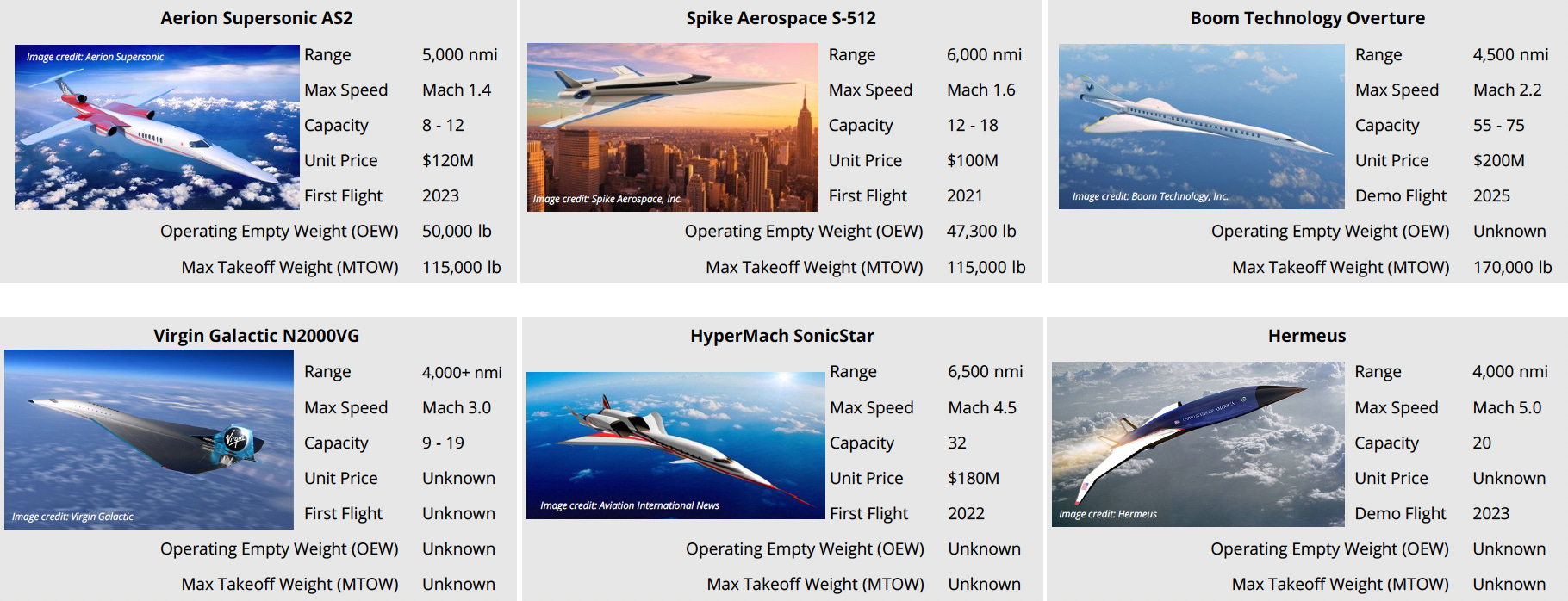
Among the top 25 city pairs, the classic JFK-LHR route showed the most potential. Deloitte’s 2021 study for NASA, however, pointed to London-Dubai as the most promising. They also offered a solid breakdown of supersonic projects in the works. Two years later, we’ve seen how things unfolded—Boom is the only company that’s actually gone supersonic, development of SonicStar and Supersonic AS2 have since been aborted.
Interesting Video: Baby Boom Goes Supersonic 🛩️
For a deep-dive on the entire test flight, check out Scott Manley’s coverage. Fun fact: Boom used an iPhone and a Starlink terminal for parts of the in-flight footage—though they had more advanced cameras following along as well. Scott breaks down the engines nicely: the XB-1 runs on three General Electric J85-15 turbojet engines, while the Overture will use Boom’s in-house design, the Symphony. Boom initially tried to procure engines for Overture externally but could not get an engine that met their specifications, so they recapitalized and developed their own.
Refer a Friend, Earn Rewards 🎁
Refer just one friend to Hardware FYI, and we’ll send you our complete database of resources—every design guide, article, white paper, and more!
Next Steps for Boom Supersonic
Before founding Boom, CEO Blake Scholl was a product manager at Groupon. It’s been said many times, but it’s worth repeating: “You can just do things.”
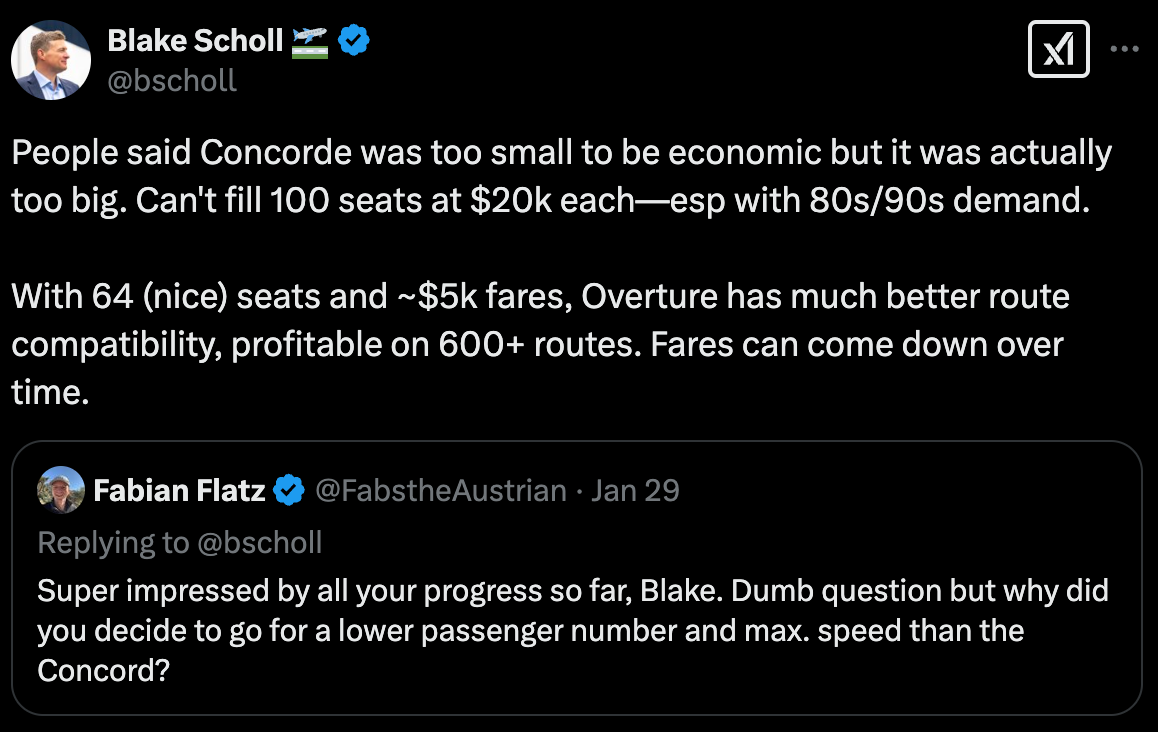
The XB-1 is about one-third the size of the Overture, Boom’s planned passenger jet. Designed to carry 64 to 80 passengers, the Overture will be smaller than the average commercial airliner, with an expected price tag of around $200 million per aircraft. Boom has already secured orders and pre-orders for 130 jets from United Airlines, American Airlines, and Japan Airlines.
For engine development, Boom is collaborating with Kratos Defense & Security Solutions to develop proprietary engines. If successful, the aircraft will be capable of cruising at Mach 1.7—twice as fast as the fastest commercial planes from Airbus or Boeing. This speed could cut flight times in half, making routes like London to Miami possible in under five hours and Los Angeles to Honolulu in just three. Boom aims for the Overture to serve more than 600 routes worldwide.
It’s a historic feat in aviation history—especially as a private commercial venture.
Manufacturing & Startup News
More leftovers from our weekly research in hardware and manufacturing news:
The Bracket Bot competition at Waterloo from last weekend is now one of the largest robotics competitions ever.
Xanadu introduces Aurora, the world's first scalable, networked, and modular quantum computer.
Epirus secures a $17M contract from the U.S. Army for directed energy weapons.
Redwire plans to acquire an UAS builder to expand its national security business for $925M, $150M cash, and $775M stock.
AST SpaceMobile raises $400M through a convertible note and receives FCC approval to begin testing its service.
Spaceium closes a $6.3M seed round for its space technology development.
OrbitAID secures $1.5M in pre-seed funding to advance on-orbit refueling and docking technology.
Momentus Space files to sell 1.5M shares following a 14:1 reverse stock split last month.
Soliddd unveils SolidddVision smartglasses to improve sight for people with macular degeneration.
Tokamak Energy installs a $1M gyrotron to boost fusion energy performance.
Starlight Partner Program launches to help build EV charging networks.
Revise Robotics introduces automated systems for refurbishing and reselling used electronics.
Space tech company Voyager files for IPO, aiming for a multi-billion dollar valuation.
Ati Motors raises $20M to expand its autonomous mobile robot business in India's growing robotics industry.
Thanks for reading to the end - if you’ve enjoyed the mechanics of these insights, consider sharing this issue with a fellow enthusiast!