
Zero-Tolerance Machining Is a Myth
The Analog #167


One quick note: speaker announcements for Kinetic are starting to roll out. Read on for the lineup, including a presentation announcement on reindustrialization and dual-use tech!

Onshape is offering hardware startups and entrepreneurs free access to Onshape Professional or Onshape Government (compliant with ITAR/EAR). Apply for the program to get started today.
Interesting Links
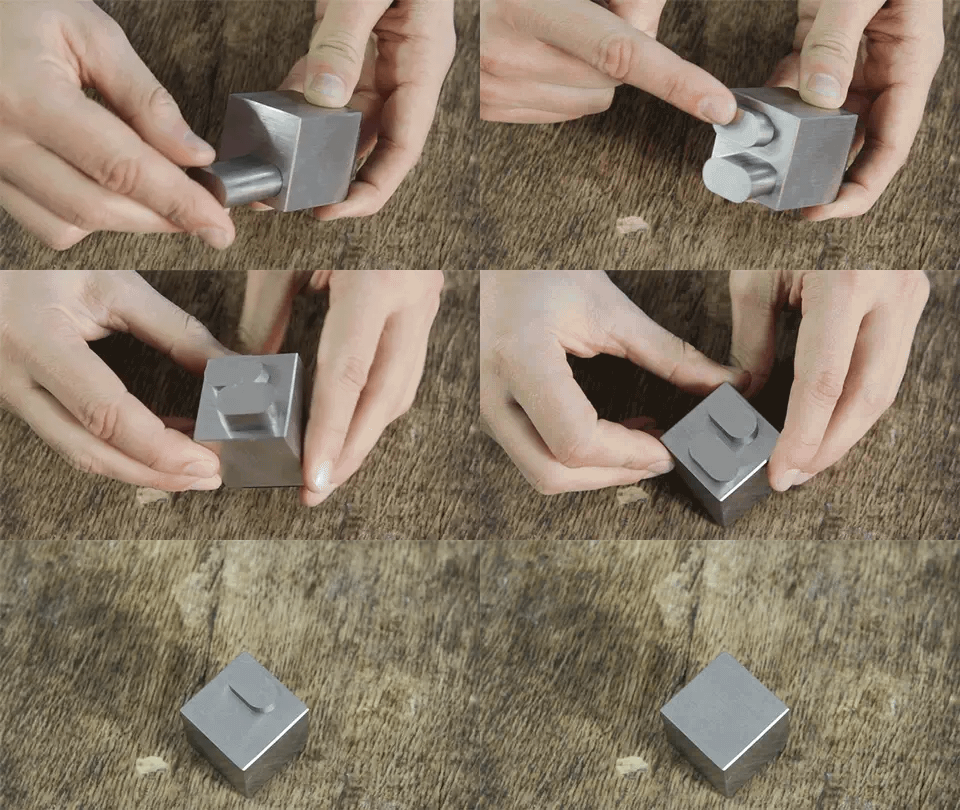
A practical explanation of how “zero-tolerance” parts are made, using wire electrodischarge machining (EDM) and in-situ grinding to erase the joint between two separately cut parts. Zero-tolerance machining isn’t a distinct manufacturing process so much as a branding shorthand, but it does point at something real in practice. Wire EDM machining can routinely hold ±5 µm (0.005 mm) tolerances; for scale, a human hair is roughly 100 µm thick, making a ±5 µm tolerance about one-twentieth of that. The process works by feeding a thin wire electrode through the workpiece while submerged in a dielectric fluid, without the wire ever contacting the material. Electrical discharges then jump the small gap between the wire and the part, eroding metal through localized melting and vaporization rather than mechanical cutting. In practice, the machine programming is relatively straightforward (mostly simple 2D paths), but achieving micron-level accuracy is not, which is why wire EDM is common in applications like medical devices and mold and die tooling. Full guide on wire EDM fundamentals here.
Turns out you can buy a machined cube like the one below for $335; expensive, but not prohibitively so.
If you've ever wanted to design your own silicon but assumed it required a $10K+ fab run and enterprise EDA tools, Matt Venn of Tiny Tapeout has created a fascinating niche by amortizing the expenses among hundreds of learners. The project aggregates hundreds of small designs onto a single shared die, splitting fab costs so individuals can tape out a working ASIC (Application Specific Integrated Circuit) for ~$300-500, and receive a chip and dev board. Users get a small tile, 8 inputs, 8 outputs, and an ancient 130nm process - with the full process of each tapeout taking 9-12 months. But it's real silicon, and the chip you receive has everyone else's designs on it too - selectable via mux. For those looking to go deeper/upskill on ASIC design, Matt Venn's Zero to ASIC course walks through the full flow. For background on how the open-source silicon movement got here, check out the IEEE paper on Tiny Tapeout.
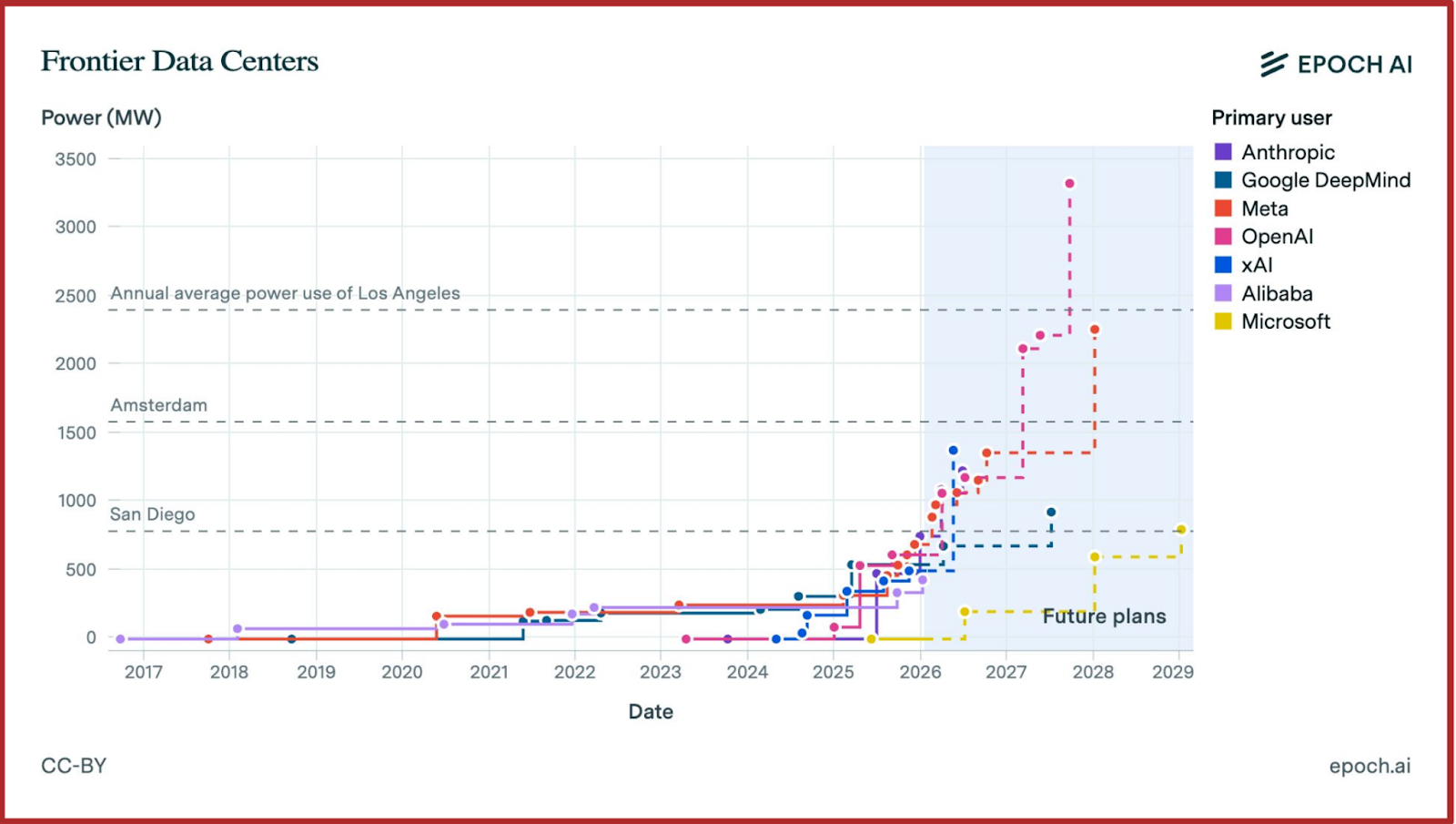
More Perfect by Christian Keil is a 346-slide report examining how technology has shaped the American union, using the country’s founding goals as a lens to evaluate large-scale societal outcomes across the past, present, and the next 250 years. Part American Dynamism manifesto, part long-arc diagnosis of the U.S., it’s also a great explanation of why energy generation has become such a dominant topic of discourse, grounded in a historical view of how societies scale through increases in per-capita energy use. In many ways, the resurgence of energy as a central topic is because the same scaling dynamic applies to AI: better models come from more training and inference compute, pushing software companies increasingly into data center buildouts and energy infrastructure. The deck also goes deep on nuclear, batteries, grid constraints, and where the U.S. electrical system is bottlenecked today.
For scale, here’s a practical sanity check on grid-scale power to show what 1 gigawatt (GW) represents in physical terms. 1 gigawatt, or 1 billion watts, represents:
100 million 10 W LED light bulbs turned on simultaneously
~1.9 million solar PV panels (assuming ~530 W per panel)
0.5× the output of Hoover Dam at peak generation
An interesting development in the EV market: Ford has reportedly held preliminary talks with Xiaomi and BYD about forming a joint venture to manufacture EVs in the U.S., according to the Financial Times (though Ford has explicitly denied the report). CEO Jim Farley has described them as technologically ahead on cost, software, and iteration speed, arguing that China—not GM, Toyota, or even Tesla—is Ford’s real competition and that these companies are “absolutely coming” to the United States. For a look at how these dynamics tend to play out over time, NPR’s 2022 investigation into vanadium battery technology is instructive: a breakthrough developed at a U.S. national lab was ultimately licensed to a Chinese manufacturer, while the original American company shut down. Technology diffusion is normal; that’s how innovation spreads. The issue is when diffusion becomes asymmetric, with manufacturing scale, state support, and IP regimes pushing value capture in one direction. For engineers, the real question isn’t whether to collaborate, but which choices around licensing, manufacturing, and supply chains determine where the value ends up.
MKBHD has a great review of Xiaomi’s electric car for a look at the international EV landscape.
One fun link to round out the week: some of Veev’s assets (one of the major modular construction startups covered in Issue #166) are being auctioned off over the next few weeks.
DRCY: AllSpice’s AI Design Review Agent
Meet DRCY, AllSpice’s AI-powered agent built specifically for hardware design reviews. DRCY runs first-pass checks on schematics and datasheets to surface critical errors early, such as config errors, voltage mismatches, and much more. Hardware teams can spend less time on rechecks, more time innovating, and ship with confidence.
Give DRCY a try here. →
Startup News
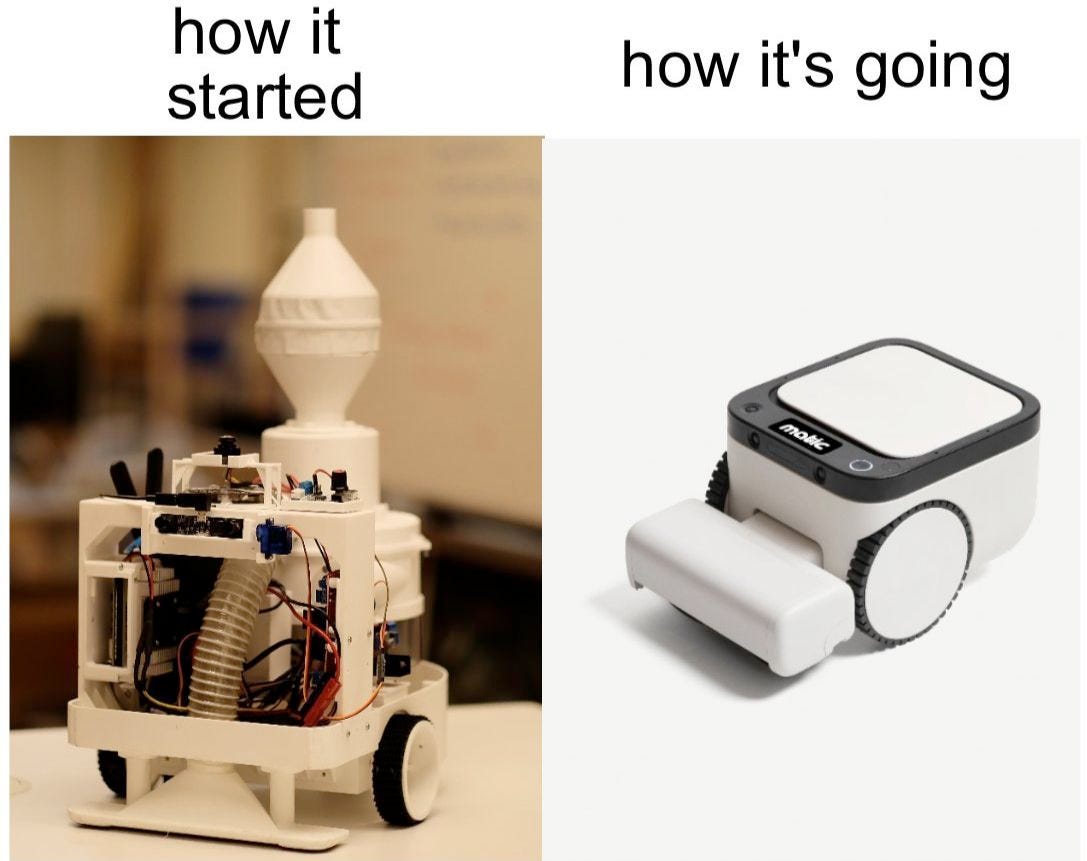
Matic raised $60M in new funding to scale its autonomous floor-cleaning robot, positioning itself as a high-end successor to the Roomba at a moment when the category’s incumbent is pulling back. The company has shipped ~6,000 robots, which have collectively cleaned over 110M square feet inside homes. All units are assembled and tested in Mountain View, California, with the round framed as a product-first, real-homes-first approach to physical AI.
Waabi raised a $750M oversubscribed Series C round and expanded into robotaxis through a partnership with Uber, marking its first move beyond autonomous trucking. In total, the deal includes $1B in new funding when combined with ~$250M in milestone-based capital from Uber tied to deploying 25,000+ Waabi Driver–powered robotaxis on Uber’s platform. Waabi is betting its simulation-first autonomy stack can scale across both trucking and ride-hailing, a dual-vertical approach that prior efforts (like Waymo’s freight program) ultimately abandoned. The round was co-led by Khosla Ventures and G2 Venture Partners.
Northwood Space raised a $100M Series B round and secured a $49.8M contract with the U.S. Space Force to expand satellite ground control capacity. The company builds electronically steered, multi-beam phased-array ground stations that support simultaneous links across LEO, MEO, and GEO, replacing legacy parabolic dishes that can only support one satellite at a time. The round was co-led by Washington Harbour Partners and a16z, as the Pentagon looks to commercial hardware to keep pace with rapidly growing satellite fleets.
Vention raised $110M in a Series D round to expand its software-defined industrial automation platform. The company combines modular hardware with machine design and robotic programming software to reduce integration time for factory automation projects. The round included Investissement Québec, Desjardins Capital, Fidelity Investments Canada, and NVIDIA’s NVentures.
Blue Origin announced TeraWave, a planned 5,408-satellite LEO/MEO constellation aimed at enterprise, government, and data-center connectivity rather than mass-market consumers. Unlike Starlink, which focuses on consumer broadband and direct-to-cell services, TeraWave is positioned as a high-bandwidth, high-reliability network for critical operations—closer to backbone-class infrastructure than consumer internet.
Reindustrialization and the Case for Dual-Use Tech.
Our first Kinetic speaker announcement is one of our own readers: Kael Saever! He’ll dig into dual-use tech and reindustrialization using Whisper Aero’s electric propulsion as a case study in how serious aviation and defense hardware can be developed through commercial products—starting with a leaf blower.

Open Jobs
More jobs added weekly on our job board. If you’re hiring, promote your open role here.
Sponsored:
Starpath, a startup developing hardware to mine lunar water ice for rocket propellant, is hiring for roles in Hawthorne, CA:
More Roles:
Uber is looking for a Manager, Autonomous Vehicle Programs in San Francisco, CA
Shield AI is looking for an Electrical Engineer in Dallas, TX
Pyka is looking for a Mechanical Engineering Intern in Alameda, CA
Tools From Our Sponsors
Manufacturing
Loombotic – Instant-quote custom wire harnesses. Upload drawings or design online, fast turnaround.
Blitzpanel – Custom control panels made fast and easy. Design online for instant pricing or let us design for you.
Express Manufacturing, Inc. – Southern California’s largest EMS provider with 40+ years of end-to-end electronics manufacturing expertise.
Summit Interconnect – Quick-turn complex rigid, flex, and rigid-flex PCBs.
Fictiv – On-demand custom manufacturing from prototype to production.
Design & Simulation
Quilter – Fully automates PCB layout with physics-driven AI.
nTop – Computational design to accelerate product development.
Onshape – Cloud CAD with real-time collaboration and version control.
Ops & Collaboration
Doss – Adaptive ERP for orders, inventory, and production.
Access Every Link We’ve Ever Shared 🎞️
Refer three friends to Hardware FYI and unlock our full archive.
Missed an issue? Hunting for that one link? Every tool, guide, and article we’ve ever shared is in here.
P.S. If you find something interesting—an article, tool, funding round, project, really anything—send it our way.
P.P.S. 17,750+ engineers, founders, and operators read this newsletter. If you want to reach them, get in touch.