
Application Notes as Cultural Artifacts
The lost art of engineering writing, Toyota's lean origins, and de-institutionalizing your career.


Topics worth your time this issue: the lost art of application notes as engineering writing, what SPICE can teach us about confusing output with understanding, the Toyota Production System handbook that seeded lean manufacturing, and an engineer's guide to de-institutionalizing your career.

Interesting Links
Application notes occupy a strange and useful corner of engineering writing. Simply defined, these are technical guides from component makers showing engineers how to design real circuits around their parts: equal parts practical, specific, occasionally funny, and one of the few places where the author is still allowed to sound like a person. At their best, they read like a senior engineer passing craft to an apprentice they will never meet, with some of the most memorable application notes now cultural artifacts of the early analog era. Jim Williams’ Switching Regulators for Poets: A Gentle Guide for the Trepidatious is one of the great examples that is a guide to the LT1070 switching regulator family, but really about making a feared circuit topology approachable to engineers. Williams walks through five working circuits of increasing difficulty: a 5V-to-12V boost, two –48V telecom supplies (one isolated through a transformer, one not), a 100W off-line switcher that rectifies the AC wall outlet directly, and a pair of loops driving a small motor and a Peltier cooler.
A switching regulator converts one DC voltage to another (up, down, or across an isolation barrier) by rapidly switching a transistor and using an inductor to transfer energy between input and output. More efficient than the linear regulators they replaced and common in nearly every modern electronic device; has a reputation for being difficult to design.

SPICE, or ‘Simulation Program with Integrated Circuit Emphasis’, began in the early 1970s at Berkeley as a circuit simulation program for analog electronics, and over time became part of the default workflow for circuit design. Describe a circuit in software, and it will tell you what the circuit should do before you build the thing on a bench. What’s All This Spicey Stuff, Anyhow? is Bob Pease’s four-part monologue about what was lost in that transition, and a warning against the seemingly innocuous habit of letting tools do your thinking for you. The broader point isn’t that SPICE was useless, but with newer and better tools it becomes easier to mistake output for understanding (think CAD, FEA, autorouters, now AI copilots). Every generation gets its own version of this trap that boil down to the same truth: tools should confirm your understanding, not generate it.
Once, a customer called me up and asked me how to get my LM108s to stop oscillating in his circuit. He explained it was a simulated LM108 with some simulated feedback resistors, and simulated switches and filters. Hmmmm. I asked if he has made up a breadboard, and if it oscillated. He said he had made it and it didn’t oscillate. Hmmmm. I asked him, “If you build up a breadboard and a computer model, and the real breadboard oscillated, but the computer did not, you wouldn’t be calling up to complain, would you?” He stopped and thought about it. He cogitated for a while. He said, “I’ll call you back.” And he hung up. He never did call back. I mean, what would you do?
Bill Hammack, better known as The Engineer Guy, has another instant classic on the engineering behind bicycle helmets. A helmet has three jobs: prevent penetration, reduce peak impact force, and, in newer designs, limit rotational acceleration of the skull. The outer shell protects against sharp objects and keeps the foam intact while the expanded polystyrene liner (same material family as packing peanuts, much denser in helmet designs) does the real work by crushing on impact and spreading the impulse over a longer period of time. Most of the wave/honeycomb inner shells that protect from rotational injury make use of auxetic structures that crumple and fold in selective directions — a property that, unlike regular hexagonal meshes, also allows them to conform to the curved surface of a human head.
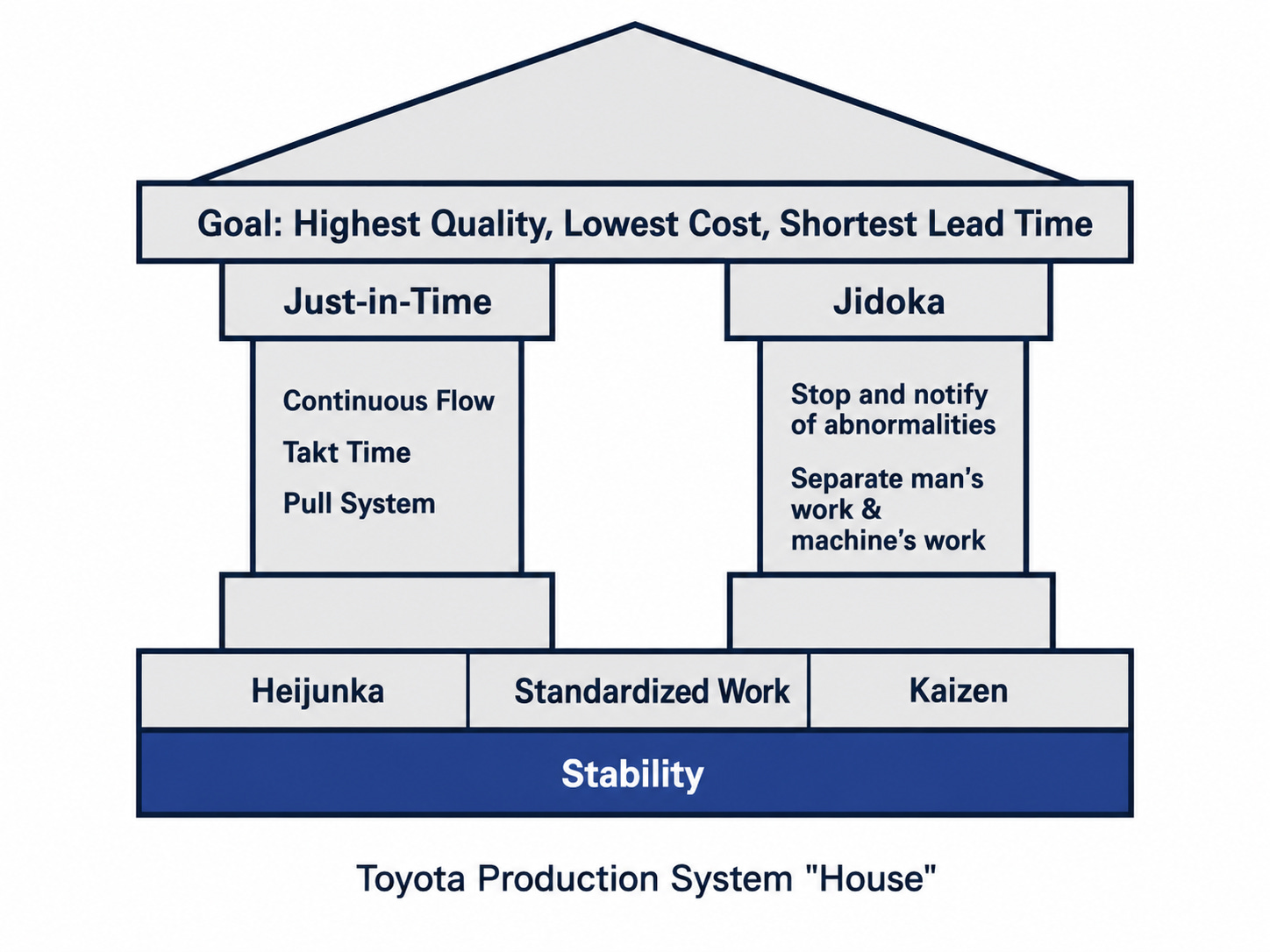
The Toyota Production System (TPS) Basic Handbook is a 33-page primer on the ideas that became modern lean manufacturing, before half of them were converted into conference room names and corporate manufacturing theater. Just-in-Time (JIT) was coined by Kiichiro Toyoda in 1937 because Toyota was too poor to carry excess inventory or equipment; the discipline means producing only what’s needed, when it’s needed, in the quantity needed. Jidoka, the system’s second pillar, is centered around the idea that automation makes intelligent decisions. Machines are designed to stop themselves at the first sign of trouble rather than keep running and compounding the defect. That automatic stop frees operators from monitoring duty and puts them to higher-leverage work. The core idea is to design the system so problems surface immediately, then fix the cause instead of padding the process with inventory, labor, or hidden workarounds.
We highly recommend reading Casey Handmer’s Career Development Guide for Job Seekers in full. It’s written from the perspective of a former NASA/JPL engineer turned startup founder at Terraform, and is full of truthful career nuggets you rarely hear stated plainly.
Working at NASA (or any other company that’s big or old enough to have recursive process control meta-documents) has institutionalized you. If you insist on only working at companies with processes compatible to the very peculiar way things were done at JPL, you are cutting yourself off from 99.999% of the opportunity described in the previous paragraph. Therefore, to have the best chance of turning your career around in a productive way, you need to recognize this fact and take active measures to de-institutionalize yourself with maximum urgency and maximum effort.
And one fun link to round out the week:
Testing the most popular 3D prints on MakerWorld - the standout is this standby dock for iPhones.
A quick question for you: would you watch video podcasts/interviews from our team, or should we stick to writing and go even deeper? I’ve been increasingly tempted by expanding formats, but keep coming back to a line Dwarkesh wrote in his podcast strategy doc — if he, as a host, can’t extract real insight from hours of conversation, the audience won’t either.
Presented by Onshape: Professional Access, 6 Months Free
Onshape provides browser-based CAD and PDM that empowers engineering teams to design and iterate without the friction of files, manual versioning, or local installs. Early adopters in diverse industries report up to 60% faster collaboration workflows and fewer errors, allowing teams to innovate and move designs forward more confidently. With the Onshape Discovery Program, qualified users get up to six months of free Professional access, making it easier to evaluate modern CAD workflows and their impact on productivity.
Learn more below. 👇

Startup News
PhysicsX raised $300M in Series C funding at a ~$2.4B valuation to expand its AI engineering simulation platform. The London-based startup builds models that predict how physical systems behave, letting aerospace, automotive, and semiconductor teams test design changes faster than conventional simulation workflows. The company expects revenue close to $50M this year and counts Applied Materials, Siemens, and Stellantis as customers. Temasek led the round, with Nvidia and Applied Materials returning as investors.
Westmag emerged from stealth with $11M in seed funding to manufacture drone motors and robot actuators in the U.S. The company is ramping production in South SF, where it designs, winds, assembles, and tests motors and actuators on a shared production platform. Westmag says it already has committed customer orders for hundreds of thousands of units and is investing upstream in stator steel stamping and rare earth magnet finishing. Andreessen Horowitz led the round, with Founders Fund, Lux Capital, NFDG, and Menlo Ventures participating.
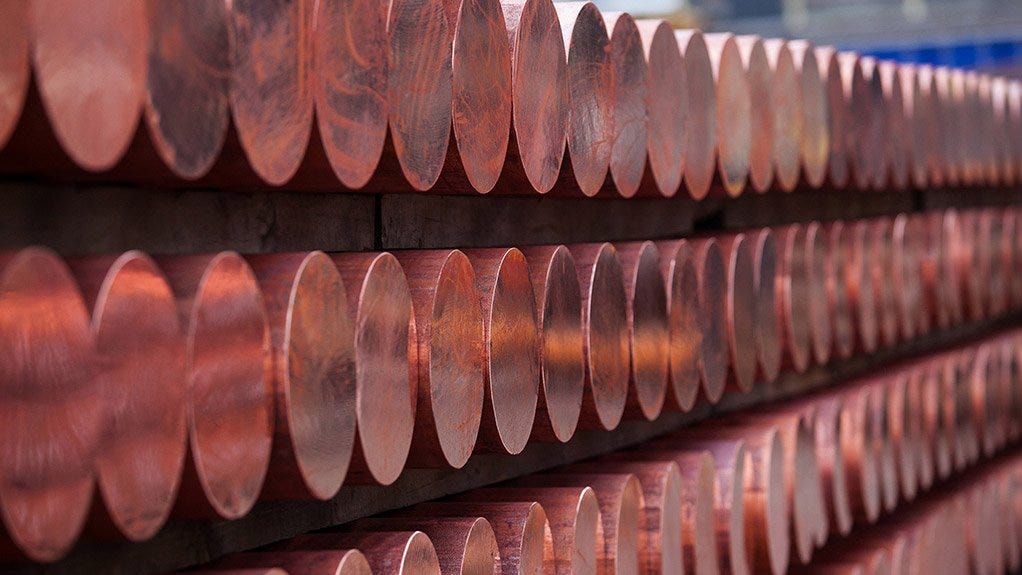
Red Metals raised $10M in seed funding to recover copper from scrap and turn it directly into copper rod. The Charleston-based startup is building a $70M facility in South Carolina that will sort copper from discarded products like electric motors and wiring, then skip several intermediate refining steps normally used in mined copper production. Red Metals says the U.S. collects roughly 1.6M metric tons of copper scrap annually, compared with about 2M metric tons of new copper demand, and plans to build its own supply chain from consumers, data centers, and other large scrap sources. Gigascale Capital led the round.
Mach Industries raised $300M in Series C funding to scale production of autonomous defense systems. The company has five systems in development, including a jet-powered VTOL aircraft, high-altitude weapons glider, airborne surveillance platform, low-cost counter-drone interceptor, and long-range munitions launcher. Infinite Capital and Ribbit Capital led the round.
Helion raised $465M in Series G funding to build Orion, its first fusion power plant, with a target to deliver electricity to Microsoft as early as 2028. The Washington-based company has now raised $1.5B total and is using the capital to scale manufacturing and move from prototype machines toward commercial deployment. Helion’s reactor uses pulsed magnetic compression, then attempts to convert the expanding plasma’s magnetic-field energy directly into electricity instead of using heat to boil water and spin a turbine. Thrive Capital led the round.
Open Jobs
More jobs added weekly on our job board. If you’re hiring, promote your open role here.
Early Career:
Shinkei is looking for a Build Mechanical Engineer in El Segundo, CA
Hermeus is looking for a Propulsion Development Engineer in Los Angeles, CA
Mid-Level:
Snap is looking for an Electrical Signal Integrity Engineer in Boulder, CO
Doordash is looking for an Electrical Engineer (Dot) in Oakland, CA
Senior to Staff:
unspun is looking for a Head of Textile Engineering in Emeryville, CA
Prolific Machines is looking for a Senior Software Platform Engineer in Emeryville, CA
Tools From Our Sponsors
Manufacturing
Express Manufacturing, Inc. – Southern California’s largest EMS provider with 40+ years of end-to-end electronics manufacturing expertise.
Fictiv – On-demand custom manufacturing from prototype to production.
Loombotic – Instant-quote custom wire harnesses. Upload drawings or design online, fast turnaround.
Blitzpanel – Custom control panels made fast and easy. Design online for instant pricing or let us design for you.
Design & Simulation
nTop – Computational design to accelerate product development.
Onshape for Startups – Free access to Onshape Professional or Onshape Government (compliant with ITAR/EAR) for hardware startups and entrepreneurs.
Access Every Link We’ve Ever Shared 🎞️
Refer three friends to Hardware FYI and unlock our full archive.
Missed an issue? Hunting for that one link? Every tool, guide, and article we’ve ever shared is in here.
P.S. If you find something interesting—an article, tool, funding round, project, really anything—send it our way.
P.P.S. 20,000+ engineers, founders, and operators read this newsletter. If you want to reach them, get in touch.