
Inside the Humanoid Stack
The Analog #168


Two quick programming notes: Kinetic speaker announcements are rolling out — including a special announcement below.
This week’s happy hour will also feature product demos and recruiting from Zipline, Matic Robots, and Meter.

Onshape is offering hardware startups and entrepreneurs free access to Onshape Professional or Onshape Government (compliant with ITAR/EAR). Apply for the program to get started today.
Interesting Links
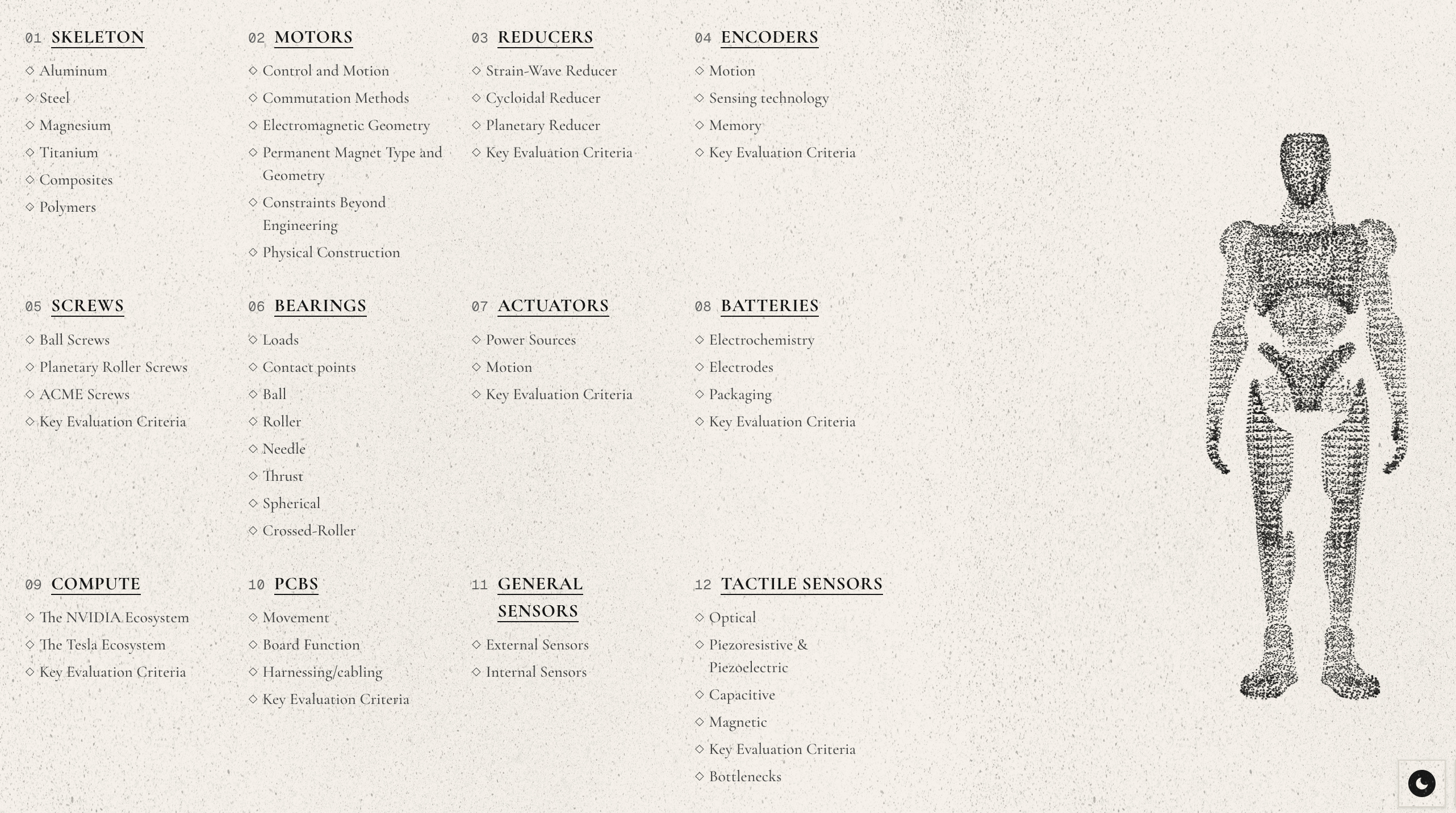
Humanity’s Last Machine is a deep dive report on humanoid hardware, starting from the components and working outward to everything they pull into their orbit across the landscape of startups, key suppliers, and geopolitics. The site itself is inseparable from the report and a clean example of what good technical research can look like (PDF version linked for offline reading). Written by investors and builders in the space, it spans everything from mechanical hardware to sensing and compute, with the heaviest attention on actuation where industry bottlenecks are most pronounced. Some gems from the report that we learned while reading:
Actuators and joint assemblies are the largest and least scalable cost in the BOM, with a typical humanoid using ~25–30 actuators. For reference, Unitree’s joint actuators average around $300 per unit.
Compute is largely standardized today, with most humanoids relying on NVIDIA’s Jetson platform to avoid the cost and risk of custom silicon. The primary exception is Tesla, with Optimus running on its in-house FSD SoC. Compute is judged on TOPS (trillions of operations per second) for neural network inference, TOPS per watt for power efficiency, and memory bandwidth.
The U.S. and China differ in capital deployment, with U.S. investment favoring software and ML and China focused on hardware scale through existing EV, drone, and consumer electronics supply chains.
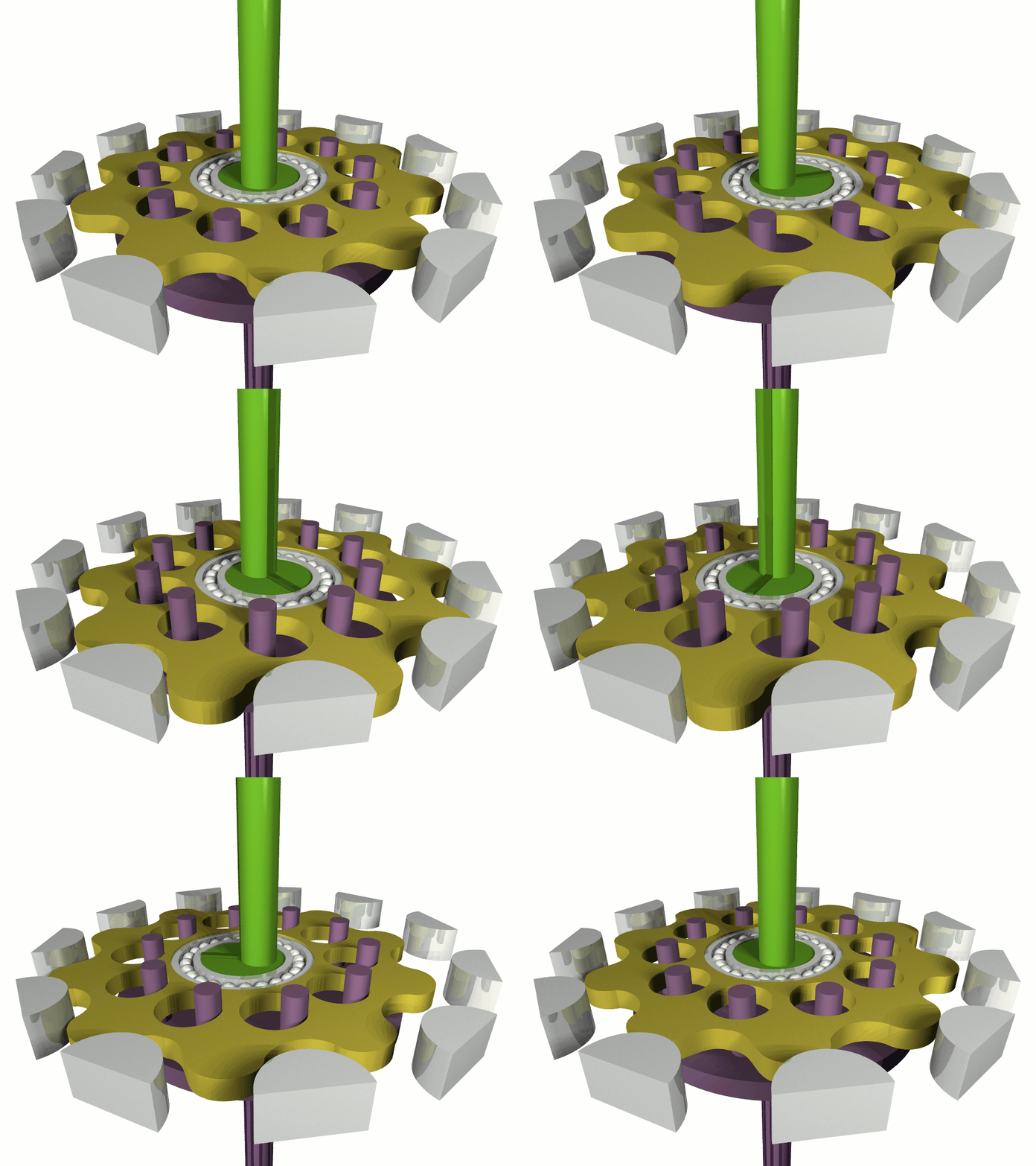
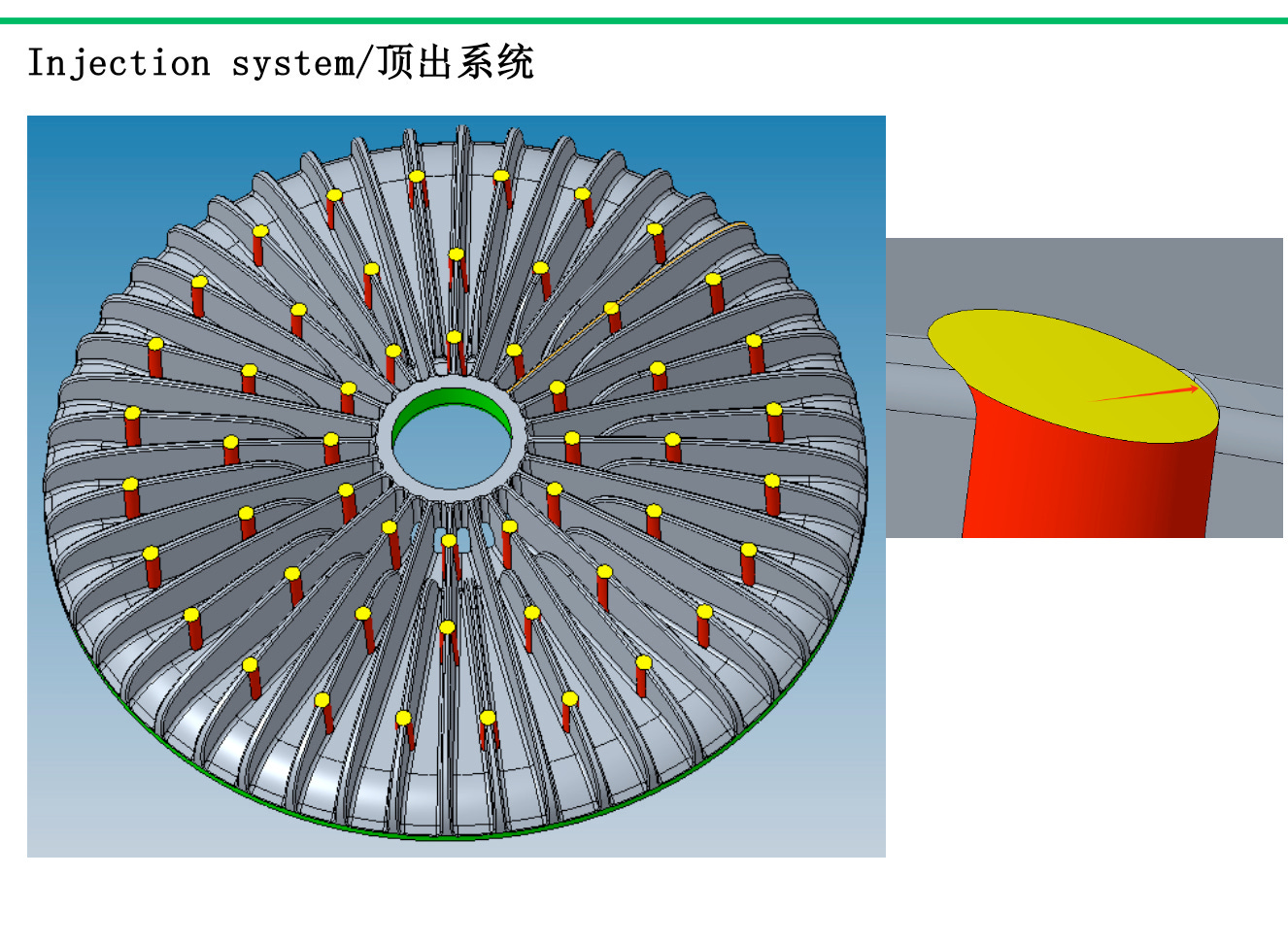
On a related note around actuation architectures, this build log is a useful look at one branch of low-reduction, backdrivable actuator designs used in humanoids. A quasi-direct drive actuator is a term initially popularized by MIT with its Mini Cheetah actuator, effectively pairing a large-diameter BLDC motor with a low-ratio gearbox integrated into the joint. In this build implementation, a cycloidal planetary reduction replaces traditional involute gear teeth with continuous lobe profiles to achieve near-zero backlash and constant contact in a form factor well-suited to 3D printing. QDD-style actuators of this class are commonly used in high-torque joints like the waist, hips, and knees, as well as in industrial applications. Compared to high-reduction gearboxes, they trade stiffness and load-holding for back-drivability and force feedback. More on strain-wave and planetary systems (the other dominant architecture) in Issue #142.
Lessons Learned Shipping 500 Units of My First Hardware Product is a field report on building and shipping a consumer hardware product, written by a software engineer doing it for the first time. The product is a 50,000-lumen floor lamp first launched through crowdfunding, pushing the work from a single prototype into n > 1 design with international suppliers. He frames the transition to scale through Murphy’s Law: anything not precisely specified and tested will fail—usually at the worst possible moment. Berens’ hard-learned lessons are worth noting for anyone approaching their first production run: (1) validate demand before committing capital via preorders, (2) overspecify everything in drawings and supplier communication, (3) visit suppliers early and often, and (4) charge enough to absorb the inevitable mistakes.
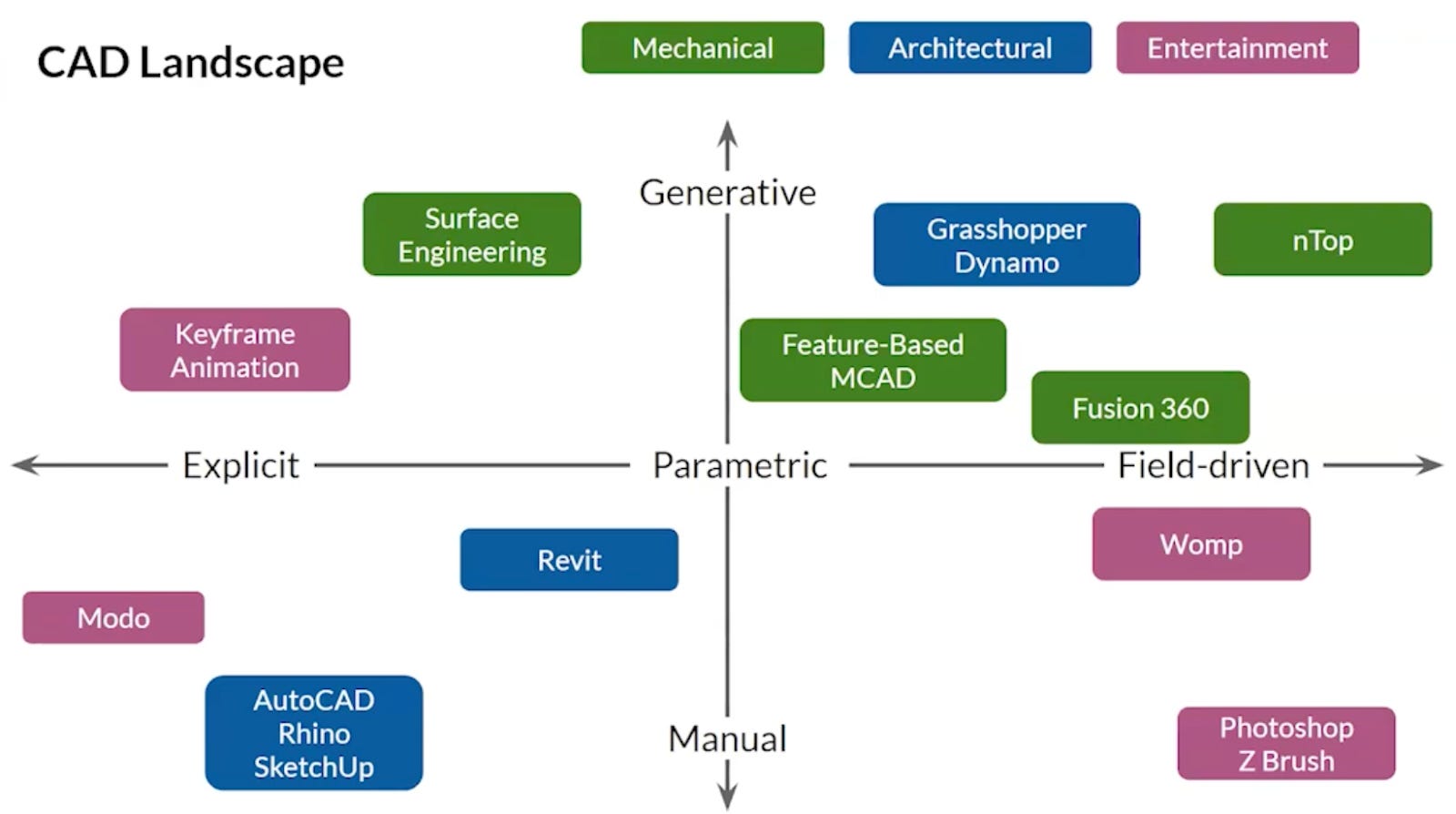
Blake Courter (former nTopology CTO, now at Gradient Control Laboratories) lays out a framework for where CAD is headed in this interview, mapping design tools along two independent axes: parametric vs. explicit modeling, and manual vs. generative workflows. These don’t necessarily travel together; parametric tools can be non-generative, or vice versa. The deeper issue he points to is data scarcity: engineering firms hold drawings and models as IP for legitimate competitive reasons, and the data that does exist is largely useless at the part level. The real unlock for AI in engineering requires translating generational knowledge into formats usable by both humans and machines. Courter’s main term is “geometry as code,” where the code is the shape itself rather than a script operating on a proprietary kernel. With implicit modeling (defined by mathematical fields rather than boundary-based surfaces), construction becomes transparent and geometry can be open-source, enabling systems to understand CAD models directly as a potential path around the data bottleneck.
A very useful free interview prep resource for early-career engineers, written by a UMich undergrad with multiple mechanical engineering internships. It covers the technical fundamentals that show up in first-round interviews, along with worked problems drawn from real interview questions. Also includes practical advice on how to shape the conversation during design presentation interviews and bypassing job boards by reaching out directly to early-stage team members. (This is good advice regardless of seniority.)
One fun link to round out the week, plus a new Kinetic speaker announcement:
Locks and Keys is a YouTube channel devoted to the mechanics of locks and keys. Lots of short clips on different push-push mechanisms, detents, springs, and much more.
Our next Kinetic speaker is an engineer we deeply admire: Emanuel Mourish (better known as em0sh)! He’ll present The State of (Mechanical) Software Engineering, breaking down what today’s engineering software gets wrong, why it keeps missing real workflows, and what engineers actually need.

CoLab: AI that applies your design history to every future decision
When past decisions aren’t documented, your team ends up making the same mistakes and duplicating work. With CoLab AI, you upload a model or drawing and AI surfaces lessons learned from past reviews. Those lessons include a link to exactly where and when on the CAD or drawing that feedback was left. So, your team sees why the design is the way it is. See CoLab AI in action →

Startup News
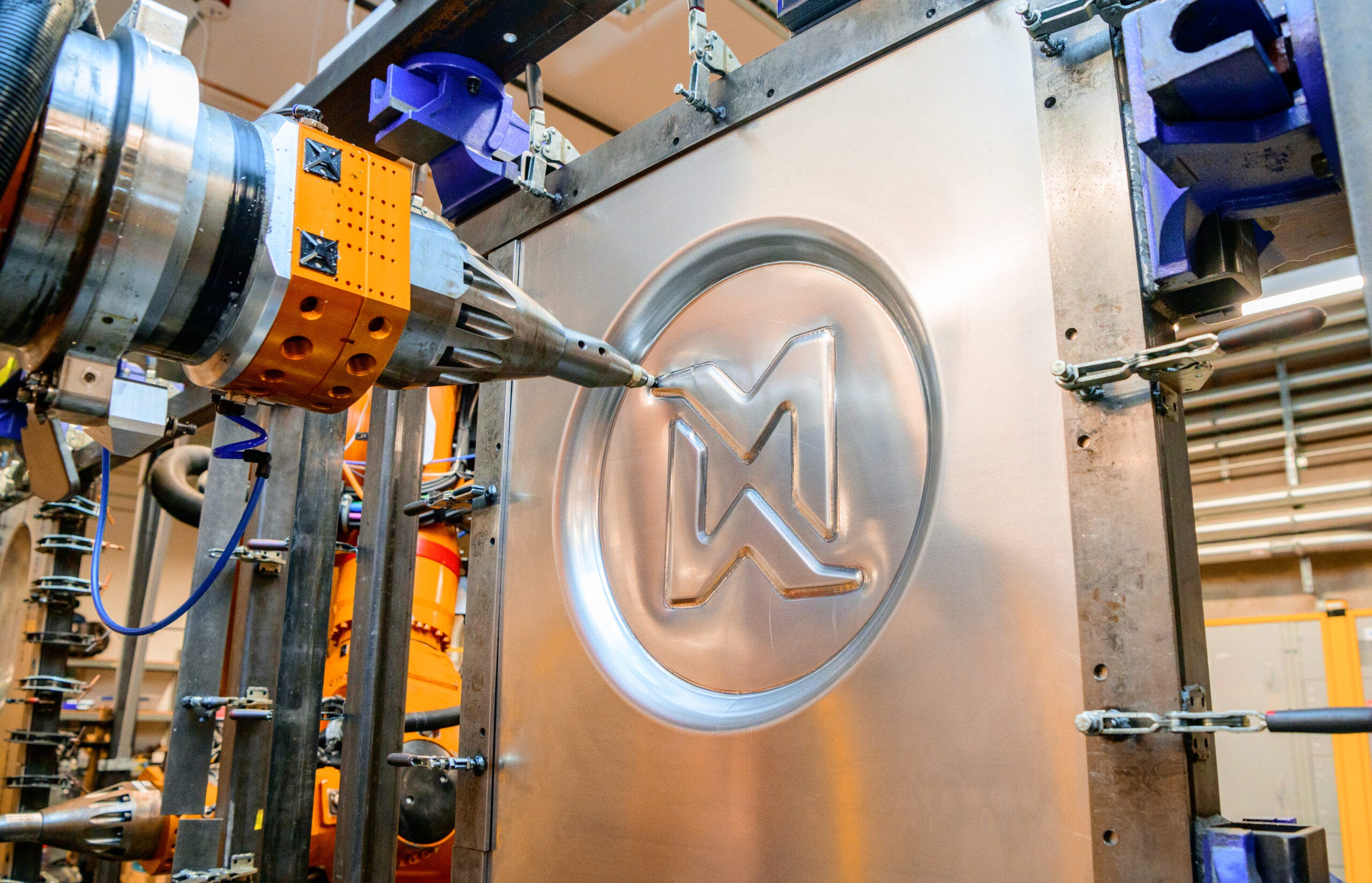
Machina Labs raised $124M in a Series C round to scale its software-defined manufacturing infrastructure and build a large-scale robotic manufacturing facility focused on missile structures and airframes. The capital will fund a 200k sq ft U.S. “Intelligent Factory” with up to 50 robotic forming cells, aimed at high-rate production of complex defense metal structures using software-defined roboforming. Machina already works with the U.S. Air Force and is engaging with European and Israeli partners, with revenue currently split ~70% defense and 30% commercial. The round included Lockheed Martin Ventures and Woven Capital among others.
Waymo raised $16B in new financing at a $126B post-money valuation to accelerate global deployment of its autonomous ride-hailing platform. The company reports 127M miles of fully autonomous driving and ~15M rides completed in 2025, bringing total lifetime rides past 20M. Waymo is currently operating ~400,000 paid rides per week across six U.S. metro areas and plans to enter 20+ additional cities in 2026, including Tokyo and London. The round was led by Dragoneer, DST Global, and Sequoia.
Bedrock Robotics raised $270M in a Series B round to advance autonomous operation of large excavators. The company is developing retrofit kits for existing machines and is targeting its first fully operator-less deployments later this year, moving beyond assisted autonomy to full job execution without a human in the cab. Early deployments are aimed at material handling workflows typical of earthmoving sites, and Bedrock is focused on scaling from single autonomous machines to coordinated fleets operating across construction sites. The round was led by CapitalG and Valor Atreides AI Fund.
SpaceX has officially acquired xAI, folding Elon Musk’s AI venture into his space business as part of a broader consolidation of privately held companies. Terms were not disclosed, but sources cited the deal at roughly $125B for xAI and ~$1T for SpaceX, making SpaceX now the most valuable private company to date. The merger was framed as a way to combine AI, rockets, and space-based infrastructure, with longer-term ambitions around space-based compute and energy systems.
Heron Power is raising $100–$200M at up to a $1B valuation to commercialize next-generation transformers aimed at utilities and data centers. The startup was founded by former Tesla executive Drew Baglino and is focused on solid-state transformer technology intended to replace century-old analog transformer infrastructure.
Open Jobs
More jobs added weekly on our job board. If you’re hiring, promote your open role here.
Early Career:
Apple is looking for a Noise & Vibration Engineer in Boulder, CO
Mid-Level:
Base Power Company is looking for a Power Systems Engineer in Austin, TX
Waymo is looking for a Systems Engineer, Behavioral Requirements in Mountain View, CA
Senior to Staff:
Peloton is looking for a Lead Mechanical Design Engineer in Woodinville, MA
PsiQuantum is looking for a Director of Equipment Operations in Milpitas, CA
Internships:
Archer is looking for an Electrical Test Engineering Intern in San Jose, CA
Sila Nanotechnologies is looking for a Slurry and Coating Intern in Alameda, CA
Tools From Our Sponsors
Manufacturing
Loombotic – Instant-quote custom wire harnesses. Upload drawings or design online, fast turnaround.
Blitzpanel – Custom control panels made fast and easy. Design online for instant pricing or let us design for you.
Express Manufacturing, Inc. – Southern California’s largest EMS provider with 40+ years of end-to-end electronics manufacturing expertise.
Summit Interconnect – Quick-turn complex rigid, flex, and rigid-flex PCBs.
Fictiv – On-demand custom manufacturing from prototype to production.
Design & Simulation
Quilter – Fully automates PCB layout with physics-driven AI.
nTop – Computational design to accelerate product development.
Onshape – Cloud CAD with real-time collaboration and version control.
Ops & Collaboration
Doss – Adaptive ERP for orders, inventory, and production.
Access Every Link We’ve Ever Shared 🎞️
Refer three friends to Hardware FYI and unlock our full archive.
Missed an issue? Hunting for that one link? Every tool, guide, and article we’ve ever shared is in here.
P.S. If you find something interesting—an article, tool, funding round, project, really anything—send it our way.
P.P.S. 17,750+ engineers, founders, and operators read this newsletter. If you want to reach them, get in touch.
Great article, thanks! While they have this reputation, cycloidal reducers can't practically be "zero backlash"... there is a tradeoff between friction / stiction / binding and backlash just like with spur / planetary.
Blake's account of shipping 500 units was great. Manufacturing is hard, but I also admire is Industrial Design and Engineering skills, putting everything together and then learning manufacturing and supply chain to get the product over the finish line and into the hands of customers.